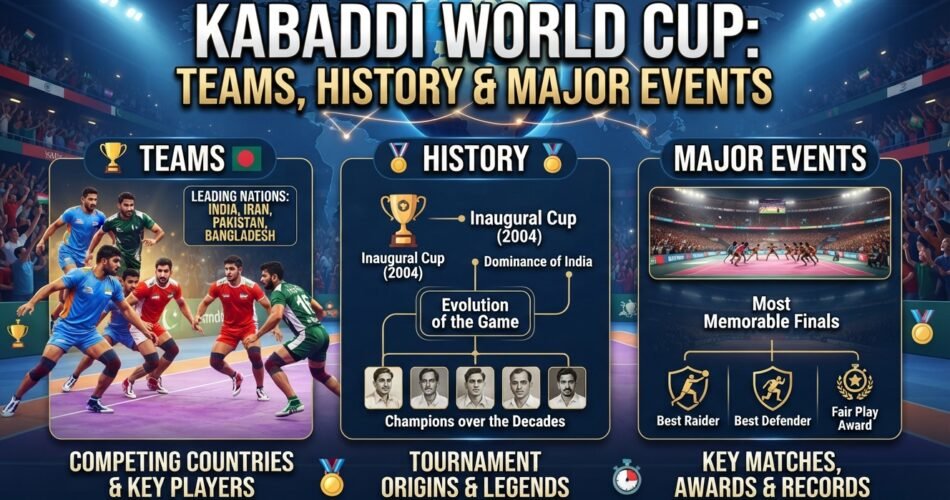
Kabaddi is one of South Asia’s most distinctive traditional sports, combining strength, speed, tactical thinking, agility, and teamwork. Over the years, the sport has developed from a regional pastime into an international competition, with national teams from Asia and other parts of the world participating in major tournaments. Among these events, the Kabaddi World Cup has become an important platform for showcasing the sport at the international level.
The World Cup brings together national teams, experienced players, emerging talent, and passionate supporters. It also provides an opportunity to understand how kabaddi has evolved and how different countries have contributed to its global development.
What Is the Kabaddi World Cup?
The Kabaddi World Cup is an international championship featuring national kabaddi teams. Matches are played under established kabaddi rules, with two teams competing to score points through raids, tackles, and defensive strategies.
A standard match features seven players from each team on the court at a time, while substitutes provide additional squad depth. The basic objective is simple: a raider enters the opposition half, attempts to score by touching defenders, and returns safely to their own half. Defenders try to stop the raider and prevent the return.
Although the rules may appear straightforward, international kabaddi requires detailed tactical planning. Teams must balance attacking raids with defensive formations, manage substitutions, and respond quickly to changes during a match.
History of Kabaddi at the International Level
Kabaddi has deep roots in the Indian subcontinent, where different versions of the sport have been played for generations. As organized sporting competitions developed, standardized rules helped kabaddi move beyond local and regional contests.
India played a major role in the early development of organized international kabaddi. The sport subsequently gained recognition in several Asian countries, including Iran, Pakistan, Bangladesh, South Korea, and Japan.
International kabaddi received another major boost through its inclusion in multi-sport competitions. Kabaddi became part of the Asian Games program in 1990, helping expose the sport to a broader international audience.
The World Cup format later provided a dedicated stage where national teams could compete specifically for a global championship. These competitions helped establish rivalries and encouraged countries to invest more heavily in coaching, player development, and professional leagues.
Major Teams in the Kabaddi World Cup
Several countries have become particularly prominent in international kabaddi.
India
India has historically been one of the central forces in international kabaddi. Its strong domestic structure, large player pool, coaching systems, and professional competitions have contributed to the country’s success.
Indian teams are known for combining powerful raiders with technically strong defenders. The country has also produced many internationally recognized kabaddi players who have helped popularize the sport.
Iran
Iran has emerged as one of India’s most significant international competitors. Iranian kabaddi is particularly recognized for its physically strong defensive approach and disciplined team structure.
Iran’s performances have helped create some of the most competitive matches in international kabaddi, making the country an important part of the sport’s modern history.
Pakistan
Pakistan has a long association with kabaddi and has developed a strong following for the sport. Its teams have competed at major international events and have traditionally emphasized physical strength and aggressive defensive play.
The rivalry between South Asian teams has contributed significantly to kabaddi’s popularity in the region.
Bangladesh
Bangladesh is another country with a deep cultural connection to kabaddi. The sport has traditionally been played throughout the country, and kabaddi remains part of Bangladesh’s sporting heritage.
Bangladesh’s participation in international competitions reflects the importance of kabaddi across South Asia.
South Korea
South Korea has developed a technically sophisticated approach to kabaddi. Korean players have demonstrated speed, tactical discipline, and effective raiding techniques.
The country’s involvement has also demonstrated that high-level kabaddi is not limited to its traditional South Asian heartland.
How Kabaddi World Cup Matches Work
Understanding the basic structure of a kabaddi match makes international tournaments easier to follow.
Each team normally has seven players on the court. One team sends a raider into the opposing half while the defending side attempts to stop the raid.
Successful raids can earn points for the attacking team. Defenders can also score points by tackling and stopping the raider. Players may be temporarily removed from the game after being tackled, but successful plays can help bring eliminated teammates back onto the court.
This creates an important strategic element. A team that falls behind can potentially recover through a series of successful raids and tackles.
Coaches therefore have to consider more than individual ability. Player combinations, defensive formations, raid selection, substitutions, and match situations all influence the outcome.
Important Kabaddi World Cup Events
The World Cup has produced several memorable moments throughout its history. Strong performances from India, Iran, Pakistan, and other national teams have helped develop international rivalries.
The tournament has also provided opportunities for younger players to compete against established international stars. Breakthrough performances can help players gain recognition and potentially earn opportunities in professional domestic competitions.
Beyond individual matches, the growth of international tournaments has helped increase media coverage and public awareness of kabaddi.
Kabaddi’s Global Expansion
One of the most important developments in modern kabaddi is its expansion beyond South Asia.
Countries from Asia and other regions have increasingly participated in international competitions. International exposure has encouraged more structured coaching programs, training camps, and national-level development.
Professional leagues have also played a role in increasing the sport’s visibility. Television coverage and digital streaming have made it possible for fans to follow kabaddi from different parts of the world.
The development of standardized rules has been particularly important because it allows teams from different sporting backgrounds to compete under the same framework.
Players and Key Skills
Successful international kabaddi players typically need a combination of physical and mental abilities.
Raiders require speed, balance, agility, timing, and the ability to identify weaknesses in defensive formations. A strong raider must make quick decisions while under pressure.
Defenders depend on strength, positioning, coordination, and anticipation. Effective tackles often require multiple players to work together at precisely the right moment.
All-rounders provide additional tactical flexibility because they can contribute in both attacking and defensive situations.
Fitness is also essential. Kabaddi involves repeated bursts of high-intensity activity, meaning players need endurance as well as explosive power.
Why the Kabaddi World Cup Matters
The Kabaddi World Cup serves several purposes for the development of the sport. It creates a competitive environment for national teams, provides international exposure for players, and helps establish kabaddi as a recognizable global sport.
For fans, the tournament offers an opportunity to compare different playing styles. South Asian teams may bring traditional tactical approaches, while teams from other regions can introduce different training methods and strategies.
International tournaments also help younger generations discover kabaddi and encourage participation at grassroots level.
Following Kabaddi as a Sports Fan
Fans interested in kabaddi can follow national teams, international tournaments, player performances, and major competitions throughout the year. Learning the basic rules is an excellent starting point, but following tactics and player roles can make matches even more interesting.
Those researching sports information online should also distinguish between official tournament information, team statistics, player news, and commercial sports services. A Trusted Betting Agent List may appear on some sports-related websites, but such information is separate from the rules, history, rankings, and official records of kabaddi competitions.
The Future of International Kabaddi
The future of international kabaddi will depend on continued investment in player development, coaching, competition structures, and global promotion. Greater participation from countries outside South Asia could make future international tournaments increasingly diverse.
Youth development will also be important. Introducing organized kabaddi programs in schools and clubs can create a larger pool of players and coaches.
Technology may further improve the viewing experience through live statistics, video analysis, player tracking, and digital broadcasting. These developments can make kabaddi easier for new audiences to understand and follow.
Conclusion
The Kabaddi World Cup represents an important chapter in the development of international kabaddi. From its traditional roots in South Asia to its growing international presence, the sport has developed into a competitive discipline requiring athletic ability, tactical intelligence, teamwork, and discipline.
Teams such as India, Iran, Pakistan, Bangladesh, and South Korea have contributed to the international character of the sport, while major tournaments have created memorable rivalries and opportunities for players.
As more countries become involved and professional structures continue to develop, kabaddi has the potential to reach an even wider global audience. For sports fans, understanding its history, major teams, rules, and tactical elements provides a strong foundation for appreciating one of the world’s most distinctive team sports.