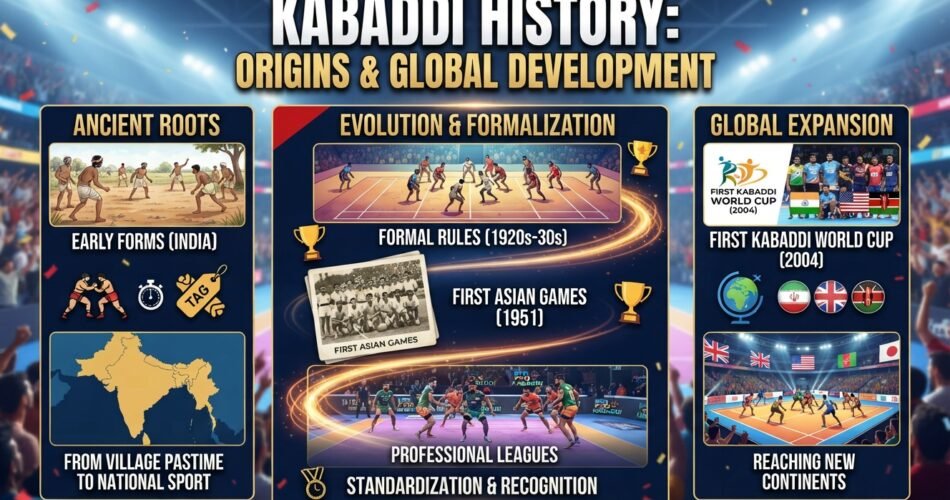
Kabaddi is one of South Asia’s most distinctive traditional sports, combining physical strength, speed, tactical awareness, and teamwork. Over time, the game has developed from a regional pastime into an organized international sport played across several continents. The history of kabaddi reflects its cultural roots while also showing how standardized rules, professional competitions, and international tournaments have helped expand its global audience.
Today, kabaddi is particularly popular in South Asia, but its competitions, leagues, and international events have introduced the sport to fans in many other parts of the world.
Origins of Kabaddi
The precise ancient origin of kabaddi is difficult to establish because traditional forms of the game existed under different names and rules across South Asia. Historical accounts and regional traditions connect forms of the sport with rural communities where physical contests were used for recreation and athletic training.
The basic concept was relatively simple: an attacking player entered the opposing team’s territory, attempted to touch one or more defenders, and returned safely to their own side. This combination of attack and defense created a sport that required speed, courage, balance, and strategic thinking.
Different regions developed their own variations. As the sport became more organized, efforts were made to establish common rules and a standardized format.
Development of Modern Kabaddi
The modernization of kabaddi accelerated during the 20th century. Organizations and sporting bodies began working toward standardized rules that could make competitions more consistent.
Traditional variations gradually influenced the organized form of kabaddi played today. Court dimensions, team structures, scoring methods, match durations, and player positions became increasingly defined.
Standardization was important because it allowed teams from different regions to compete under the same basic regulations. This eventually created a foundation for national and international competitions.
Kabaddi in India
India has played a central role in the development of modern kabaddi. The sport has deep roots in several Indian states and has traditionally been popular at school, university, village, and community levels.
Organized competitions helped transform kabaddi from a local sporting activity into a structured competitive discipline. National championships and institutional tournaments provided players with opportunities to develop their skills.
India’s strong domestic kabaddi system also helped produce generations of international players. The country has become closely associated with major kabaddi tournaments and professional competitions.
Kabaddi in Bangladesh
Bangladesh also has a long association with kabaddi. The sport is traditionally known as Ha-du-du in parts of the country and has strong cultural connections.
Kabaddi became the national sport of Bangladesh, helping strengthen its importance within the country’s sporting culture. Local competitions and national-level events have provided opportunities for players to develop and represent the country internationally.
Bangladesh has also participated in international kabaddi competitions, contributing to the sport’s broader development in South Asia.
International Expansion
Kabaddi began moving beyond its traditional South Asian base as international sporting organizations promoted standardized competitions.
National teams from countries outside South Asia began participating in international events. Countries such as Iran, Japan, South Korea, Thailand, and others developed competitive programs.
The growth of kabaddi internationally demonstrated that the sport could be adapted to new sporting environments while retaining its core identity.
International competitions have also encouraged coaches and athletes to exchange tactical ideas and training methods.
Asian Games and Kabaddi
One of the most important stages in kabaddi’s international development has been the Asian Games.
Kabaddi became a medal sport at the Asian Games in 1990. The competition provided national teams with an important continental platform and increased the visibility of the sport.
Asian Games kabaddi has featured intense competition among leading nations. India has historically been a major force, while Iran, South Korea, Pakistan, and other teams have also contributed to competitive encounters.
The tournament has helped demonstrate the technical and tactical development of modern kabaddi.
Kabaddi World Cup
The Kabaddi World Cup has provided another important international platform. It brings national teams together to compete for a global championship.
World Cup competition has helped introduce kabaddi to audiences unfamiliar with the sport. Matches between established teams have also contributed to tactical innovation and greater international interest.
Different editions and formats of international kabaddi have reflected the sport’s continuing evolution. The development of global competitions has encouraged more countries to establish training systems and national teams.
Professional Kabaddi
Professional leagues have played a major role in changing the modern kabaddi landscape.
The Pro Kabaddi League in India introduced a franchise-based model that combined kabaddi with professional sports entertainment. The league attracted major audiences and helped raise the profiles of individual players.
Professional kabaddi introduced greater exposure through television and digital broadcasting. Players gained opportunities to compete alongside international athletes, while coaches developed more sophisticated tactical systems.
The popularity of professional leagues also helped younger athletes view kabaddi as a potential professional career.
Evolution of Kabaddi Rules
Modern kabaddi has become more structured than many of its traditional versions. A standard match features two teams competing on a marked court, with players alternating between attacking and defending roles.
The raider enters the opponent’s half and attempts to score by touching defenders and returning safely. Defenders attempt to stop the raider before the return.
Scoring can involve successful raids, tackles, bonus points, and other situations defined by competition regulations. Rules regarding substitutions, reviews, timeouts, and technical decisions may vary depending on the tournament.
These standardized systems have made kabaddi easier to organize at national and international levels.
Important Kabaddi Positions
Modern kabaddi requires players with specialized skills. Raiders need speed, agility, balance, and the ability to identify defensive weaknesses.
Defenders rely on strength, timing, positioning, and teamwork. Common defensive roles include corner and cover positions, each contributing to coordinated tackles.
All-rounders combine attacking and defensive abilities. Their versatility can provide teams with additional tactical options.
The development of specialized positions demonstrates how kabaddi has evolved from a simple traditional contest into a highly organized modern sport.
Women’s Kabaddi Development
Women’s kabaddi has become increasingly important in the sport’s international development. Women compete in national championships, continental competitions, professional leagues, and international tournaments.
The growth of women’s competitions has created more opportunities for female athletes and has expanded kabaddi’s audience.
Professional and international events have also helped improve visibility for women’s kabaddi, encouraging younger players to participate in organized programs.
Kabaddi’s Global Future
The future development of kabaddi depends on continued international participation, youth development, professional opportunities, coaching, and broadcasting.
Countries outside South Asia have already demonstrated growing interest in the sport. International tournaments provide opportunities for emerging teams to gain experience against established opponents.
Improved training facilities and standardized coaching can further strengthen the global competitive structure. Digital broadcasting can also introduce kabaddi to audiences that may have never encountered the sport before.
For readers exploring sports-related commercial information, a Trusted Betting Agent List may appear in connection with kabaddi content, but official sporting organizations remain the appropriate sources for tournament rules, schedules, results, and competition information.
Why Kabaddi Remains Unique
Kabaddi stands apart from many other team sports because of its combination of individual raids and coordinated defensive play. A single raid can change the momentum of a match, while a successful defensive sequence can dramatically alter the score.
The sport also requires players to make decisions within seconds. Raiders must judge when to attack, which defender to target, and when to retreat. Defenders must coordinate their movements without giving the raider an easy escape route.
This mixture of physical competition and tactical decision-making gives kabaddi its distinctive character.
Conclusion
The history of kabaddi demonstrates how a traditional South Asian game developed into a modern international sport. Its roots lie in regional forms of physical competition, while standardized rules, national organizations, the Asian Games, international championships, and professional leagues have helped shape its modern identity.
India and Bangladesh remain important parts of kabaddi’s cultural history, while countries across Asia and beyond continue to develop competitive programs. With growing professional opportunities, women’s participation, youth development, and international exposure, kabaddi has established a distinctive place in the global sporting landscape.