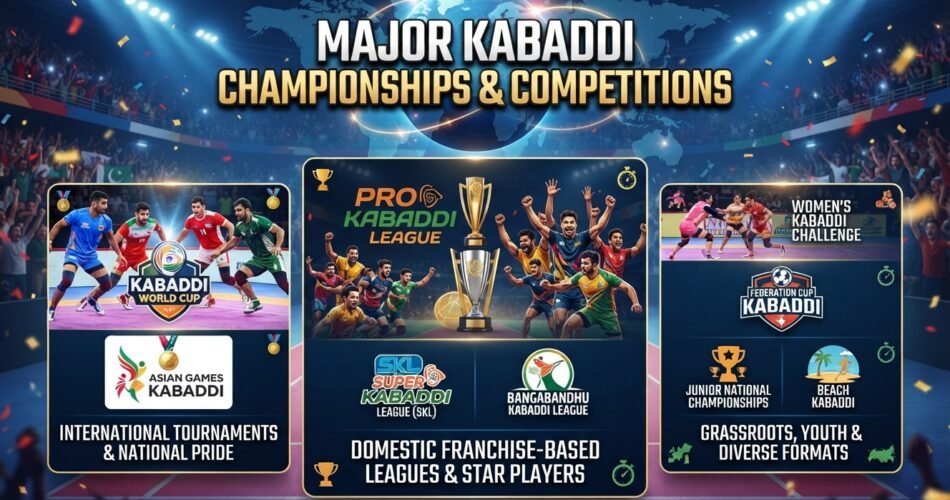
Kabaddi is a traditional South Asian sport that has developed into an internationally recognized competitive game. Combining speed, strength, agility, tactical awareness, and teamwork, kabaddi attracts dedicated audiences across Asia and an increasing number of fans worldwide. From international championships to professional leagues and multi-sport competitions, the sport now has a diverse competitive calendar.
Understanding the major kabaddi championships and competitions helps fans follow the development of the sport, recognize important teams, and learn how different tournaments are structured.
What Is Kabaddi?
Kabaddi is a team sport in which two teams compete on a marked court. Each side generally has seven players on the playing surface at a time.
The attacking player, known as the raider, enters the opposing team’s half and attempts to score points by touching defenders before returning safely. The defending players attempt to stop the raider through coordinated tackles.
The sport requires a combination of individual ability and team strategy. Raiders need speed, balance, timing, and awareness, while defenders rely on positioning, strength, communication, and coordinated tackling.
Modern kabaddi is played under standardized rules, allowing teams from different countries to compete in international tournaments.
Kabaddi World Cup
The Kabaddi World Cup is one of the most recognizable international competitions associated with the sport. It brings national teams together to compete for a global championship.
India has historically been a major force in international kabaddi, while countries such as Iran, Pakistan, Bangladesh, and South Korea have also developed strong national programs.
World Cup competition provides national teams with opportunities to test their tactical systems against international opponents. It also helps introduce kabaddi to audiences that may be less familiar with the sport.
Different editions and formats of the World Cup have contributed to the development of international kabaddi and helped establish important rivalries.
Asian Games Kabaddi
The Asian Games are among the most important multi-sport competitions in Asia, and kabaddi has been part of the event since 1990.
The inclusion of kabaddi in the Asian Games significantly increased its international profile. National teams compete for medals, making the tournament an important target for players and coaches.
Asian Games kabaddi has featured strong competition among established teams. India, Iran, Pakistan, South Korea, and other Asian nations have contributed to the tournament’s competitive history.
Because the event includes many sports, success at the Asian Games also gives kabaddi valuable exposure to a broader sporting audience.
Asian Kabaddi Championship
The Asian Kabaddi Championship is another important international competition. It brings together leading national teams from across Asia.
The tournament provides an opportunity for teams to gain international experience outside the Asian Games and World Cup cycles. It can also serve as preparation for larger competitions.
Asian kabaddi is particularly competitive because the continent has many countries with established kabaddi traditions and training programs.
Kabaddi Masters
Kabaddi Masters competitions have provided another international platform for elite national teams. Such events can bring leading sides together in shorter tournament formats.
These competitions can be useful for teams preparing for larger championships because coaches can evaluate players, test tactical systems, and identify areas for improvement.
International events also provide players with experience against different defensive and attacking approaches.
Pro Kabaddi League
The Pro Kabaddi League has played an important role in the modern commercialization and popularization of kabaddi.
The professional league features franchise teams competing in a structured season. It has helped transform kabaddi into a major televised sporting product in India and introduced the sport to new audiences.
The league also provides a platform for young players to compete alongside experienced professionals. Its emphasis on presentation, statistics, player auctions, and televised matches has helped modernize the way fans consume kabaddi.
Many international players have also participated in professional kabaddi competitions, creating additional opportunities for cross-border development.
Domestic Kabaddi Competitions
Domestic tournaments remain important for identifying and developing players. Local, state, and national-level competitions can provide pathways toward professional and international careers.
India has a particularly extensive kabaddi structure, with competitions at different levels. Other countries with established kabaddi programs also use domestic tournaments to develop talent.
Grassroots competitions are important because they allow young players to develop fundamental skills before entering higher-level competition.
Women’s Kabaddi Competitions
Women’s kabaddi has also become increasingly visible through international and domestic competitions.
Women’s national teams compete in major international events, while professional and regional competitions provide additional opportunities for female players.
Greater investment in women’s kabaddi can help expand participation, create stronger national teams, and introduce the sport to new audiences.
International women’s competitions also demonstrate that kabaddi can provide competitive opportunities across both men’s and women’s sport.
Important Kabaddi Playing Positions
Understanding player roles makes kabaddi competitions easier to follow.
Raiders
Raiders are responsible for entering the opposition half and attempting to score points. Successful raiders combine speed, agility, balance, and tactical awareness.
Defenders
Defenders attempt to stop opposing raiders. They must work together and select the right moment to tackle.
All-Rounders
All-rounders contribute in both attacking and defensive situations. Their versatility can provide coaches with additional tactical options.
Supporting Players
Successful kabaddi teams rely on coordinated movement and communication from the entire squad. Even players who do not frequently make raids can have an important defensive or tactical role.
How Kabaddi Championships Are Structured
Kabaddi competitions can use different formats depending on the number of participating teams and the event’s objectives.
Some tournaments use group stages followed by knockout rounds. Teams first compete against several opponents before the strongest sides advance to the quarter-finals, semi-finals, and final.
Other competitions may use league formats in which teams accumulate points throughout a season.
Professional leagues often include regular-season fixtures followed by playoffs. International championships may use shorter tournament formats because national teams assemble for specific periods.
Understanding the format helps fans interpret standings and recognize the importance of individual matches.
Key Factors in Kabaddi Matches
Several factors can influence the outcome of a kabaddi match.
Physical fitness is essential because players repeatedly perform high-intensity movements. Tactical organization is equally important, particularly during defensive situations.
A team’s ability to manage substitutions and maintain concentration can also affect performance.
Raid selection is another important factor. Raiders must decide when to attack aggressively and when to avoid unnecessary risks.
Defensive coordination can change the momentum of a match. A successful tackle can remove a key opposition player and create opportunities for the defending team.
International Growth of Kabaddi
Kabaddi has traditionally been strongest in South Asia, but international participation has expanded over time.
Countries outside the sport’s traditional base have developed national teams and training programs. International competitions give these teams valuable experience and encourage further investment.
Professional leagues have also helped introduce kabaddi to audiences unfamiliar with its traditional form.
Digital streaming and social media have made it easier for international fans to discover tournaments, players, and teams.
Following Kabaddi Competitions
Fans can follow kabaddi through tournament websites, sports broadcasters, official team channels, sports news platforms, live-score services, and social media.
Important information includes match schedules, results, tournament standings, player statistics, team announcements, and competition rules.
When researching commercial sports-related services, readers may encounter a Trusted Betting Agent List. Such information is separate from official kabaddi tournament records and should not be confused with authoritative schedules, results, rankings, or championship information.
For reliable sporting information, fans should consult official competition organizers and established sports sources.
Why Kabaddi Championships Matter
Major competitions provide more than championship trophies. They create opportunities for players to develop, coaches to test strategies, and national federations to improve their programs.
International tournaments also create rivalries that can increase public interest. Matches between established kabaddi nations can attract significant attention because players are familiar with one another and teams often have contrasting tactical styles.
Professional leagues add another layer by providing regular competition and commercial exposure.
Together, these championships create a pathway from grassroots participation to domestic competition, professional leagues, and international representation.
The Future of Kabaddi Competitions
The future of kabaddi will depend on continued development at both domestic and international levels. Youth programs can provide a steady supply of new players, while better coaching and sports science can improve performance.
International expansion could also introduce kabaddi to more countries. More tournaments, stronger national programs, and improved broadcasting could increase the sport’s global audience.
Women’s kabaddi represents another important area for growth. Expanding competitions and development programs can create more opportunities for female athletes.
Technology will also influence the sport. Video analysis, player statistics, fitness monitoring, and improved broadcasting can provide fans and coaches with deeper insight into matches.
Conclusion
Major kabaddi championships and competitions have helped transform the sport from a traditional South Asian game into an increasingly international discipline. The Kabaddi World Cup, Asian Games, Asian Kabaddi Championship, professional leagues, and domestic tournaments each play different roles in the sport’s development.
International championships provide national teams with high-level competition, while professional leagues create regular opportunities for players and bring kabaddi to larger audiences. Domestic and grassroots competitions remain essential for developing future talent.
As international participation continues to expand, kabaddi has opportunities to reach new audiences and strengthen its competitive structure. For fans, understanding the major tournaments, team roles, competition formats, and history provides a useful foundation for following one of the world’s most dynamic team sports.