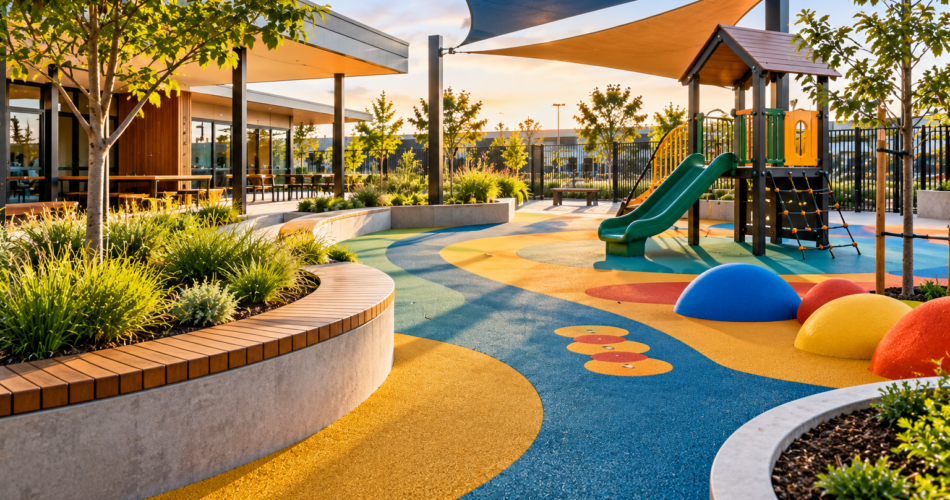
For Melbourne landscaping businesses, wet pour rubber surfacing Melbourne projects are increasingly relevant where an outdoor area needs more than a hard, decorative finish. Childcare playgrounds, school play areas, recreation spaces and selected outdoor facilities need surfaces that are practical, easy to maintain and appropriate for the way the space will be used.
Wet pour rubber is not simply rubber spread over the ground. The finished surface depends on the substrate, drainage, rubber system, binder, thickness and installation method. Getting those details right is what makes a wetpour rubber surfacing project perform properly.
What is wet pour rubber?
Wet pour rubber is a bonded surfacing system made by mixing rubber granules with a polyurethane resin binder and laying the mixture over a prepared base. Unlike loose-fill materials, the rubber is formed into a continuous surface that can follow curves, edges and different landscape shapes.
Garden More uses wet pour rubber surfacing for applications including playgrounds, childcare centres, schools, recreation areas and other outdoor spaces where a resilient finished surface is required.
The material can also be installed in different colours and patterns. In a childcare setting, that means the surface can become part of the play design rather than simply being a plain area underneath the equipment.
The base matters more than most people realise
One of the biggest mistakes with wet pour installation is treating the rubber layer as the whole project.
Before rubber is mixed and laid, the site needs to be prepared properly. At Garden More, the installation process includes removing unsuitable vegetation, establishing levels, preparing the base, compacting the crushed-rock foundation and considering how water will leave the area.
Garden More’s existing installation specification uses a compacted 20 mm crushed-rock road base, with the depth determined by ground conditions, followed by fine crushed material to achieve the required finished level. Drainage and falls are addressed before the rubber is installed.
This is particularly important around playgrounds. If water is allowed to sit underneath or around the finished surface, problems can develop regardless of how good the rubber mixture is.
What are the layers in a wet pour rubber system?
A typical wet pour rubber system uses more than one layer.
The lower layer generally provides the impact-attenuating cushion and is commonly made from rubber granules bonded with polyurethane resin. A finer rubber or EPDM wearing layer can then provide the finished colour and surface appearance.
The required system and thickness should be determined from the project’s performance requirements rather than simply choosing a thickness because it looks appropriate.
This is where experienced installation matters. A childcare operator should be asking not only, “What colour rubber do you use?” but also, “What system is being proposed for this equipment and fall height?”
Critical fall height needs to be considered
For playground projects, critical fall height is an important technical consideration. In simple terms, it refers to the maximum free height of fall for which a surfacing system provides the specified level of impact attenuation.
The current Australian playground surfacing standard is AS 4422 (Int):2022, which provides a test method for measuring conformance of impact-attenuating surfaces against specified thresholds. It superseded AS 4422:2016.
This does not mean every wet pour surface automatically complies with a particular fall height. The equipment, free height of fall, surfacing system, thickness and test information all need to be considered for the actual project.
That distinction is important for childcare centres preparing for inspections or reviewing an existing playground. A surface should not be described as “compliant” simply because it is made from rubber.
A practical example: childcare surfacing in Kew
Consider a childcare centre in Kew replacing an ageing play surface around climbing equipment and a small slide.
The first step should not be ordering coloured rubber. The site needs to be measured and assessed, including the existing base, drainage, equipment locations and the areas where children can fall.
Once the play equipment and relevant fall zones are understood, the surfacing system can be specified accordingly. The finished design might combine green and tan rubber with coloured play markings while keeping the technical requirements of the surface at the centre of the installation.
That is the difference between treating wet pour as a decorative product and treating it as part of the playground construction.
Where wet pour rubber works well
Wet pour rubber can be considered for:
- Childcare playgrounds
- School play areas
- Public recreation spaces
- Outdoor fitness areas
- Selected pathways and activity areas
- Pool surrounds where the specified system is appropriate
- Areas requiring a continuous rubber finish
It is particularly useful where the design needs curves, graphics, colour zones or a seamless appearance.
For childcare and playground projects, however, appearance should come after the technical requirements. The surface needs to be selected and installed around the equipment, expected use and required impact performance.
Wet pour versus loose-fill surfacing
Loose-fill materials and bonded wet pour rubber have different maintenance and performance characteristics.
Loose-fill materials can move during use and may require redistribution or topping up. Wet pour is bonded into a continuous surface, so it does not need the same type of regular raking and redistribution.
Wet pour can also make it easier to incorporate permanent colour patterns and play markings directly into the surface.
That does not make it automatically suitable for every playground. The right choice depends on the equipment, site, drainage, access, maintenance requirements and project specification.
Maintenance should be planned from day one
Wet pour is generally straightforward to maintain, but it is not maintenance-free.
Leaves, dirt and other debris should be removed regularly, particularly in areas underneath trees. Surfaces should also be inspected for damage, worn areas, lifting or other changes that could affect performance.
Some council specifications recommend regular cleaning and inspection regimes for wet-pour playground surfaces, with maintenance practices such as sweeping or low-pressure cleaning and periodic deeper cleaning.
For a childcare centre, maintenance records are also useful because they provide a documented history of how the playground surface has been cared for.
Why installation experience matters
The rubber granules and polyurethane resin are only part of the job.
The finished result depends on accurate site measurement, suitable base preparation, compaction, drainage, material handling, correct mixing and consistent application. Garden More’s existing process specifically includes measuring the site, removing vegetation, compacting the crushed-rock base, screeding, arranging material delivery close to the work area and mixing and laying the rubber on site.
For Melbourne landscaping contractors, this is an important point when comparing suppliers or installers. A quote that focuses only on the square-metre rubber rate does not necessarily tell you how the finished surface will perform.
Final thoughts
Good wet pour rubber surfacing Melbourne projects start underneath the visible rubber. Base preparation, drainage, equipment layout, fall height, surfacing specification and installation technique all influence the finished result.
For a Kew childcare centre, school playground or Melbourne recreation area, wet pour rubber can provide a practical and visually flexible surface when it is properly specified and installed for the site.
Garden More provides wet pour rubber surfacing as part of its landscaping services, including site preparation, material supply and installation.
Contact Garden More or Call Now on 0415 090 719 to discuss your project.