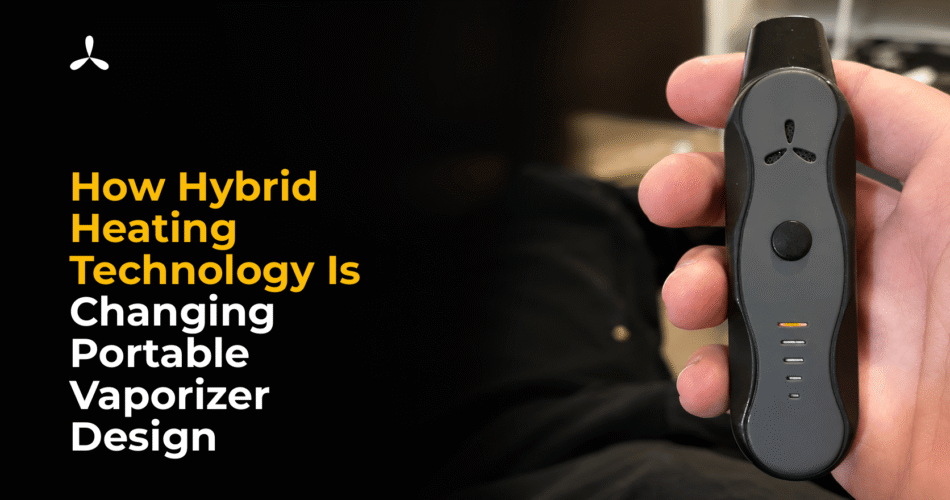
Portable dry herb vaporizers have evolved significantly over the years. What began as relatively simple heating devices has developed into a category of compact, technologically advanced products designed around temperature control, efficient heat distribution, airflow, and everyday convenience.
One of the most important developments in this evolution is hybrid heating technology.
By combining two established heating methods, conduction and convection, hybrid systems offer manufacturers new ways to manage heat transfer and improve the consistency of vaporizer performance.
For brands such as AirVape, hybrid heating also reflects a broader shift in product development: designing portable vaporizers as integrated systems rather than focusing on the heating element alone.
Understanding how hybrid heating works helps explain why modern portable vaporizer designs increasingly emphasize chamber construction, airflow engineering, temperature regulation, and thermal efficiency.
What Is Hybrid Heating Technology in a Vaporizer?
Hybrid heating technology refers to a vaporizer heating system that combines conduction and convection heat transfer.
Both methods are widely used in dry herb vaporizers, but they deliver heat to the material differently.
Conduction Heating
Conduction heating occurs when heat transfers through direct contact between the dry herb material and a heated surface, such as the walls or base of a vaporizer chamber.
In a conduction-based device, the chamber heats up and transfers thermal energy to the material placed inside.
Its characteristics include:
- Direct heat transfer through chamber surfaces
- Relatively straightforward heating architecture
- Potentially compact heater and chamber arrangements
- Continued heating of material in contact with hot surfaces
However, conduction systems can produce uneven temperature distribution when some material remains closer to heated surfaces than other portions.
Convection Heating
Convection heating transfers heat through moving air.
In a convection vaporizer, air passes through or near a heating element before traveling through the dry herb chamber.
The heated airflow then transfers energy to the material.
Convection systems can offer more distributed heating, although their performance depends heavily on airflow design, heater capacity, and drawing technique.
Hybrid Heating
Hybrid systems combine these two approaches.
The chamber surfaces provide conductive heat while heated air passing through the chamber contributes convective heat transfer.
The objective is to create a more balanced heating environment.
However, not every hybrid vaporizer uses the same ratio of conduction to convection. Some designs rely more heavily on chamber-wall heating, while others emphasize heated airflow.
This distinction matters because hybrid heating describes a combination of heat-transfer methods, not a guaranteed level of performance.
How Hybrid Heating Is Influencing Modern Portable Vaporizer Design
Hybrid heating technology affects much more than the way a vaporizer generates heat. It also influences how manufacturers arrange internal components, select materials, manage power consumption, and design the overall user experience.
1. More Sophisticated Heating Chamber Construction
The heating chamber is one of the most important components in a portable dry herb vaporizer.
In a hybrid system, the chamber must support direct thermal contact while allowing heated air to move through the material.
This creates several engineering considerations.
Manufacturers must evaluate chamber dimensions, wall thickness, thermal conductivity, airflow openings, and the placement of heating elements.
A chamber with excessive thermal mass may require more energy to heat. A chamber with insufficient thermal mass may struggle to maintain a stable temperature when cooler air enters during a draw.
Material selection is equally important.
Stainless steel, ceramic, and other heat-resistant materials offer different combinations of durability, thermal response, and ease of cleaning.
For example, the AirVape Legacy PRO 2 uses a gold-plated stainless steel heating chamber as part of its hybrid convection and conduction system.
This demonstrates how chamber material and heating architecture can be developed together rather than treated as independent features.
2. Improved Temperature Management
Temperature management is another area where hybrid heating has influenced portable vaporizer engineering.
Traditional heating systems may rely on relatively simple controls that regulate the heater according to a selected setting.
Modern devices can incorporate temperature sensors, electronic control circuits, and software-based regulation to manage heater output.
In a hybrid vaporizer, this control becomes particularly important because heat reaches the material through multiple pathways.
The device must account for factors such as:
- Heat stored in the chamber walls
- Energy transferred through moving air
- Temperature changes during inhalation
- Heat loss through the surrounding structure
- Battery voltage and available heater power
When a user draws air through the chamber, incoming cooler air can temporarily change the heating environment.
A well-designed control system responds by adjusting heater power to maintain the intended operating conditions.
However, the displayed temperature may represent a sensor measurement or control target rather than the exact temperature at every point inside the herb chamber.
This is why temperature stability and sensor placement are just as important as the number shown on a vaporizer’s display.
3. Greater Emphasis on Airflow Engineering
Airflow has become a central part of portable vaporizer design.
In hybrid heating systems, airflow performs two functions.
First, it transports heated air through the chamber, contributing to convection heating.
Second, it carries the resulting vapor through the airpath toward the mouthpiece.
The design of this pathway can influence draw resistance, heat transfer, vapor temperature, and maintenance requirements.
Manufacturers must consider the diameter and length of air channels, chamber inlet placement, internal restrictions, and the materials used in the vapor pathway.
A restricted airpath may make drawing more difficult. An excessively open design may change how long heated air remains in contact with the material.
Neither extreme guarantees better performance.
The goal is to create a controlled airflow system that complements the heater and chamber.
Modern AirVape devices illustrate this approach through their use of isolated glass airpaths in the Legacy series.
These designs also make airpath accessibility an important part of routine maintenance.
The Role of Hybrid Heating in Faster Heat-Up Times
Heat-up time is an important specification for portable vaporizers.
Users generally expect compact devices to reach their operating temperature without a lengthy waiting period.
Hybrid heating systems can support relatively fast heat-up times when the heater, chamber, insulation, and control electronics are designed efficiently.
The conductive component begins transferring heat through chamber surfaces, while the convection component contributes additional heat through airflow.
However, hybrid heating alone does not guarantee faster heating.
Actual performance depends on heater wattage, thermal mass, battery output, temperature targets, and the way readiness is measured.
For example, AirVape lists an approximately 15-second heat-up time for its Legacy PRO 2.
This is a useful example of how rapid heating can be integrated into a portable hybrid vaporizer without eliminating features such as adjustable temperature control and a removable battery.
Importantly, reaching a displayed temperature does not necessarily mean that every part of the loaded material has reached that temperature.
Heat-up specifications should therefore be considered alongside heating consistency and overall device design.
How Hybrid Heating Affects Vaporizer Size and Portability
One of the biggest challenges in portable vaporizer engineering is balancing performance with physical size.
A hybrid system may require space for heating elements, chamber insulation, airflow channels, sensors, and supporting electronics.
These components must fit inside a device that remains comfortable to hold and carry.
This creates trade-offs between compactness and thermal performance.
A smaller device may have limited space for insulation and battery capacity. A larger device can provide more room for internal components but may be less convenient for everyday portability.
Manufacturers therefore need to carefully arrange the internal layout.
For example, positioning the battery away from the hottest components can help manage thermal exposure, while effective insulation can reduce heat transfer toward the exterior housing.
Modern portable vaporizer design increasingly reflects this balance between heating capability, ergonomics, and component protection.
Hybrid technology has not eliminated these trade-offs. Instead, it has encouraged manufacturers to manage them more deliberately.
Hybrid Heating and Battery Efficiency
Battery performance is another important consideration.
Portable vaporizers rely on rechargeable batteries to supply the electrical energy required for heating.
Hybrid heating systems must distribute this energy across the heating process while maintaining reliable temperature control.
A device’s battery performance depends on several variables, including heater power, session duration, operating temperature, thermal insulation, and control efficiency.
Hybrid heating can be designed to use stored chamber heat alongside active airflow heating, but it is not inherently more battery-efficient than conduction-only or convection-only systems.
Efficiency must be evaluated at the level of the complete device.
Why Replaceable Batteries Matter
Battery replaceability has become an important design consideration for users interested in long-term ownership.
Rechargeable lithium-ion batteries gradually lose capacity through use and ageing.
In devices with permanently installed batteries, this degradation can eventually affect usability or require professional servicing.
Replaceable battery systems provide another option.
The AirVape Legacy PRO 2 incorporates a removable 18650 battery, allowing compatible batteries to be replaced without replacing the entire vaporizer.
This feature reflects a broader approach to portable device design that considers serviceability alongside performance.
Users should always follow manufacturer guidance regarding compatible batteries, charging equipment, and safe handling.
AirVape’s Approach to Hybrid Heating Technology
AirVape’s current European product range provides examples of how different heating architectures can serve different design priorities.
Its premium Legacy models incorporate hybrid heating, while more compact products such as the XS GO emphasize simpler conduction-based construction.
AirVape Legacy PRO 2
The Legacy PRO 2 combines hybrid heating with precise temperature adjustment, a gold-plated stainless steel chamber, an isolated glass airpath, a ceramic mouthpiece, and a removable battery. It demonstrates how heating performance can be integrated with advanced controls and maintainability.
AirVape Legacy CORE
The Legacy CORE also uses hybrid convection and conduction heating but offers a simpler interface with seven LED temperature levels. It demonstrates how a sophisticated heating system can be paired with straightforward controls.
AirVape XS GO
The XS GO uses conduction heating and prioritizes compactness and simple operation. It provides a useful contrast, showing that hybrid technology is one design approach rather than a requirement for every portable vaporizer.
These distinctions are reflected in AirVape EU’s official model comparison and product information.
Hybrid vs. Conduction vs. Convection: Design Differences
Understanding the three heating approaches makes it easier to evaluate their practical design implications.
| Feature | Conduction | Convection | Hybrid |
| Primary heat transfer | Direct surface contact | Heated airflow | Both methods |
| Chamber design | Heated walls or base | Airflow-focused | Integrated chamber and airflow |
| Heating consistency | Depends on contact and loading | Depends on airflow distribution | Depends on balance of both |
| Engineering complexity | Often simpler | Can require advanced airflow design | Requires coordinated heat transfer |
| Portability | Can support very compact designs | Varies by heater design | Varies by component arrangement |
| Maintenance | Chamber and contact surfaces | Airpath and chamber | Chamber and airpath |
No single heating method is automatically superior in every category.
A well-engineered conduction vaporizer may perform more consistently than a poorly designed hybrid device.
Similarly, a carefully developed convection system may offer advantages for users who prioritize airflow-driven heating.
The quality of implementation matters more than the heating label alone.
Why Maintenance Is Important in Hybrid Vaporizer Design
Hybrid heating systems combine heated chamber surfaces with airflow pathways, making maintenance an important part of long-term performance.
Over time, residue and small particles can accumulate around the chamber, screens, and air channels.
This buildup may affect airflow resistance, cleaning accessibility, and the consistency of heat transfer.
Modern vaporizer designs increasingly address these issues through removable components and accessible internal pathways.
For example, AirVape’s ONEPath system is designed to simplify airpath cleaning in supported Legacy models.
This approach reflects an important design principle: components that require regular maintenance should be reasonably accessible.
Users can support consistent device operation by following manufacturer-approved cleaning procedures, allowing components to cool before handling, and ensuring all cleaned parts are completely dry before reassembly.
Challenges and Limitations of Hybrid Heating Technology
Despite its advantages, hybrid heating introduces several engineering challenges.
More Complex Thermal Design
Managing conduction and convection simultaneously requires careful coordination between heater placement, chamber construction, and airflow.
Poorly balanced systems can develop uneven heating or inefficient energy transfer.
Potentially Higher Manufacturing Costs
Additional engineering requirements, precision components, and temperature regulation systems can increase development and manufacturing costs.
However, the final price also depends on materials, production scale, features, and brand positioning.
Heat Management Requirements
Compact devices must control how heat moves through the chamber and surrounding structure.
Insufficient insulation can contribute to uncomfortable exterior temperatures or unnecessary heat exposure for internal components.
Maintenance Considerations
Because hybrid systems involve both heated surfaces and airflow pathways, residue management can require attention to several components.
Accessible construction can reduce this burden, but it does not eliminate routine cleaning.
The Future of Hybrid Heating in Portable Vaporizers
Hybrid heating is likely to remain an important area of portable vaporizer development because it offers manufacturers flexibility in how they manage heat transfer.
Several engineering directions may shape future products.
More responsive temperature control: Improvements in sensors and control algorithms could help devices respond more precisely to changes in airflow and thermal demand.
Better thermal insulation: Advanced insulation arrangements could help reduce unwanted heat transfer to exterior surfaces and nearby electronics.
More serviceable construction: Replaceable batteries, accessible airpaths, and modular components may support longer practical device lifespans.
Smarter power management: Improved heater regulation could help manufacturers balance heating performance with battery runtime.
Refined airflow systems: Continued development of chamber geometry and air channels could support more consistent heating across different loading conditions.
These are potential development directions rather than guarantees that every future hybrid vaporizer will include them.
The central challenge will remain the same: combining heating performance, compact dimensions, manageable power consumption, and straightforward maintenance.
Frequently Asked Questions
Is hybrid heating better than convection heating?
Not necessarily. Hybrid heating combines direct chamber heating with heated airflow, while convection heating primarily relies on moving hot air. Performance depends on the quality of the complete device design, including temperature regulation, chamber geometry, and airflow.
Does hybrid heating make a vaporizer heat up faster?
It can support fast heat-up times, but the heating method alone does not determine speed. Heater power, chamber materials, thermal mass, and control systems all influence how quickly a vaporizer reaches its target temperature.
Are hybrid vaporizers more energy-efficient?
Not automatically. Battery efficiency depends on the entire heating system, including power management, insulation, operating temperature, and session duration.
Why is airflow important in a hybrid vaporizer?
Airflow contributes to convection heating and transports vapor through the device. Its design influences heat distribution, draw resistance, and the overall operation of the vaporizer.
Which AirVape models use hybrid heating?
According to AirVape EU official comparison guide, the Legacy PRO 2 and Legacy CORE both use hybrid convection and conduction heating.
Final Thoughts
Hybrid heating technology is changing portable vaporizer design by encouraging a more integrated approach to thermal engineering.
Instead of evaluating chamber heating and airflow separately, manufacturers can develop systems in which both methods contribute to the heating process.
This influences chamber construction, temperature regulation, airflow pathways, battery requirements, insulation, and maintenance accessibility.
AirVape’s Legacy PRO 2 and Legacy CORE illustrate how hybrid heating can be incorporated into portable devices with different levels of user control and functionality.
Ultimately, the significance of hybrid heating is not simply that it combines two technologies. It is that the combination gives designers more options for balancing performance, portability, consistency, and long-term usability.
For anyone comparing modern portable dry herb vaporizers, understanding these engineering principles provides a more useful foundation than relying on heating terminology alone.