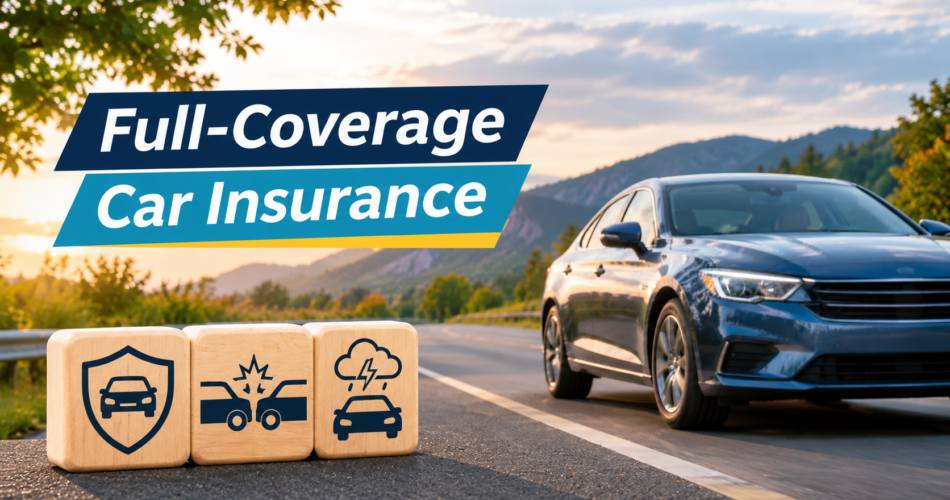
If you have searched for “full-coverage car insurance” expecting to find a single, standardized policy, the first thing worth knowing is that no such policy category exists. Full coverage is an informal insurance term, not an official designation. It generally refers to a combination of three major coverages: liability protection, collision insurance, and comprehensive insurance.
Understanding what each coverage actually protects, what it excludes, and how much financial responsibility remains with you can help you decide whether this combination is appropriate for your vehicle and financial situation.
The Three Coverages Behind the Term
Liability coverage is the foundation of most personal auto insurance policies in the United States. Nearly every state requires drivers to demonstrate financial responsibility, commonly through liability insurance, although specific requirements and permitted alternatives vary by state.
Liability coverage generally includes two components:
- Bodily injury liability: Helps pay for medical expenses, lost wages, and other covered damages when you cause injuries to another person in an accident.
- Property damage liability: Helps pay for damage you cause to another person’s vehicle or property.
Liability coverage does not ordinarily pay to repair your own vehicle or cover your own injuries. That is where collision and comprehensive coverage become important.
Collision insurance pays for covered damage to your vehicle resulting from a collision with another vehicle or object. For example, if you back into a pole, slide on ice into a guardrail, or collide with another car, collision coverage can help pay for repairs regardless of who was responsible for the accident.
If the vehicle is declared a total loss, the insurer generally pays its actual cash value immediately before the accident, minus your applicable deductible, subject to policy terms.
Comprehensive insurance covers certain types of vehicle damage that do not result from a collision. Common examples include:
- Vehicle theft
- Hail and storm damage
- Flood-related damage
- Fire
- Vandalism
- Falling trees or other objects
- Damage caused by striking an animal
Despite its name, comprehensive insurance does not cover every possible type of damage. Coverage is subject to the policy’s exclusions, conditions, and deductible.
Together, liability, collision, and comprehensive coverage form the combination most people mean when they refer to full-coverage car insurance.
However, the actual protection depends on your selected limits, deductibles, optional coverages, and policy terms. Two drivers who both describe their insurance as full coverage may have significantly different financial protection.
How Deductibles Affect What You Actually Receive
An insurance deductible is the amount you are responsible for paying toward a covered claim before your insurer pays the remaining eligible amount.
Collision and comprehensive coverage commonly have separate deductibles. You generally select these amounts when purchasing or updating your policy.
For example, suppose your vehicle sustains $3,000 in covered collision damage and your collision deductible is $500. Your insurer would generally pay $2,500, assuming the entire repair amount is covered and no other adjustments apply.
A higher deductible generally reduces your insurance premium, while a lower deductible usually increases it.
However, selecting the highest available deductible simply to reduce your monthly premium is not always a sensible decision. If a repair costs less than your deductible, you may have to pay the entire amount yourself. Even when the damage exceeds your deductible, you should consider the repair cost, claim circumstances, and potential effect on future premiums before filing.
For a major accident or covered storm loss, a deductible represents an expense you must be prepared to handle before receiving the applicable insurance payment.
The right deductible is therefore less about finding the lowest number and more about choosing an amount you can comfortably afford without creating financial difficulty.
Why Lenders Require Collision and Comprehensive Coverage
If you financed your vehicle through a bank, credit union, or dealership, your loan agreement will commonly require both collision and comprehensive coverage for as long as the lender has a financial interest in the vehicle.
This requirement protects the lender’s collateral. If the vehicle is damaged, stolen, or destroyed, the lender wants to ensure that its financial interest is protected.
Dropping the required coverage while the loan is outstanding may violate your financing agreement. Depending on the contract, the lender may obtain insurance on your behalf, commonly referred to as force-placed insurance, and charge you for the cost.
Force-placed insurance generally protects the lender’s interest rather than providing the same level of protection you would receive through your own comprehensive and collision policy. It can also be considerably more expensive than purchasing appropriate coverage yourself.
For financed vehicles, therefore, collision and comprehensive coverage are generally contractual requirements rather than optional choices.
For vehicles that are completely paid off, the calculation changes.
If your vehicle has a relatively low market value, the cost of maintaining collision and comprehensive coverage may approach the amount you could realistically receive from a covered claim. In that situation, some drivers decide that liability-only coverage is a reasonable option.
There is no universal age or mileage at which you should drop these coverages. Instead, compare your annual premiums, deductibles, current vehicle value, and ability to pay for repairs or replace the vehicle yourself.
Also remember that removing collision and comprehensive coverage does not reduce your responsibility for meeting your state’s minimum financial-responsibility requirements.
What Full Coverage Does Not Automatically Include
One of the biggest misunderstandings about full-coverage car insurance is assuming that the term guarantees protection against every driving-related expense.
Even a policy containing liability, collision, and comprehensive coverage does not automatically include:
- Medical payments coverage: Helps pay eligible medical expenses for you and your passengers following an accident.
- Personal injury protection (PIP): Can cover medical expenses and, depending on the state and policy, lost wages and other accident-related costs.
- Uninsured/underinsured motorist coverage: Helps protect you when an at-fault driver has no insurance or insufficient insurance. Depending on the state and policy, it may cover injuries and certain property damage.
- Roadside assistance and towing: Helps cover eligible roadside services, such as towing, battery assistance, or lockout services.
- Rental reimbursement: Helps pay eligible rental vehicle expenses while your car is being repaired after a covered loss.
- Gap insurance: Can cover some or all of the difference between your outstanding vehicle loan or lease balance and the vehicle’s insurance settlement after a covered total loss, subject to the agreement’s terms.
Some of these protections are optional, while others may be required by state law or specific circumstances.
For example, “full coverage” requires PIP or uninsured motorist coverage, while other states allow drivers to decline particular protections under specified conditions.
The phrase “full coverage” does not guarantee that any of these additional protections are included. Reviewing your policy declarations page and coverage documents is the best way to understand exactly what you have purchased.
Matching Coverage to Your Situation
The right combination of auto insurance coverage depends on your vehicle, financial circumstances, driving habits, and state requirements.
The following examples provide a starting point for evaluating your needs.
| Situation | Coverage to consider | What to evaluate |
| Financed or leased vehicle | Collision and comprehensive | Check the loan or lease agreement for required coverage and deductibles. |
| Older vehicle with a low market value | Liability-only may be sufficient. | Compare annual premiums and deductibles against the vehicle’s current value. |
| Vehicle parked in a high-theft or severe-weather area | Comprehensive | Consider exposure to theft, hail, flooding, fire, and other covered non-collision losses. |
| New or high-value vehicle that is paid off | Collision and comprehensive | Evaluate the potential replacement cost and whether you could absorb a major loss yourself. |
| Driver with limited emergency savings | Collision and comprehensive | Consider whether paying for repairs or replacing the vehicle independently would create financial hardship. |
These are general guidelines rather than universal recommendations. A paid-off vehicle, for example, may still justify collision and comprehensive coverage if replacing it would be financially difficult.
Policy Limits Matter as Much as Coverage Type
Choosing the right types of coverage is only part of the insurance decision. You also need to consider the limits that determine how much your insurer may pay for covered losses.
For liability insurance, the limits determine the maximum amount available for covered bodily injury and property damage claims. If you cause a serious accident and the resulting damages exceed your policy limits, you may be personally responsible for the remaining amount.
For collision and comprehensive coverage, the insurer generally bases a total-loss settlement on the vehicle’s actual cash value immediately before the covered loss, minus the applicable deductible. This amount reflects depreciation and is not necessarily equal to the vehicle’s original purchase price or the remaining loan balance.
For example, if your vehicle’s actual cash value is $18,000 and your applicable deductible is $1,000, the general settlement amount would be $17,000, assuming there are no other adjustments.
If you still owe $21,000 on the vehicle, you could face a $4,000 difference between the insurance settlement and your outstanding loan balance. This is one situation in which GAP coverage may be worth considering.
Drivers sometimes focus on whether they have full coverage without paying sufficient attention to their liability limits, deductibles, and total-loss protection.
A policy that includes the three main coverages but carries low liability limits may still leave you exposed to substantial financial risk.
Getting Quotes That Reflect What You Actually Need
Full-coverage car insurance is a combination of coverages rather than a fixed insurance product, so the quotes you compare should reflect the protection you actually want.
Pay particular attention to the following:
- Liability limits: Compare the bodily injury and property damage limits across policies.
- Collision deductibles: Make sure you understand how much you would pay toward an eligible collision claim.
- Comprehensive deductibles: Check the amount you would owe for covered theft, weather, fire, or vandalism losses.
- Optional coverage: Determine whether PIP, uninsured motorist protection, rental reimbursement, roadside assistance, or GAP coverage is included.
- Policy exclusions: Review circumstances in which the insurer may not provide coverage.
- Total premium: Compare the overall cost for equivalent coverage rather than focusing only on the monthly payment.
For example, comparing a policy with a $500 deductible against one with a $1,500 deductible is not an apples-to-apples comparison, even if both are advertised as full coverage.
If sorting through these variables feels complicated, speaking with a licensed insurance agent can help. An agent can explain the trade-offs based on your vehicle, driving history, financial circumstances, and coverage requirements.
For drivers ready to explore their options, a practical next step is to compare Full-Coverage Auto Insurance Quotes with the help of a licensed professional, which will aid in understanding coverage costs and what it can realistically protect.