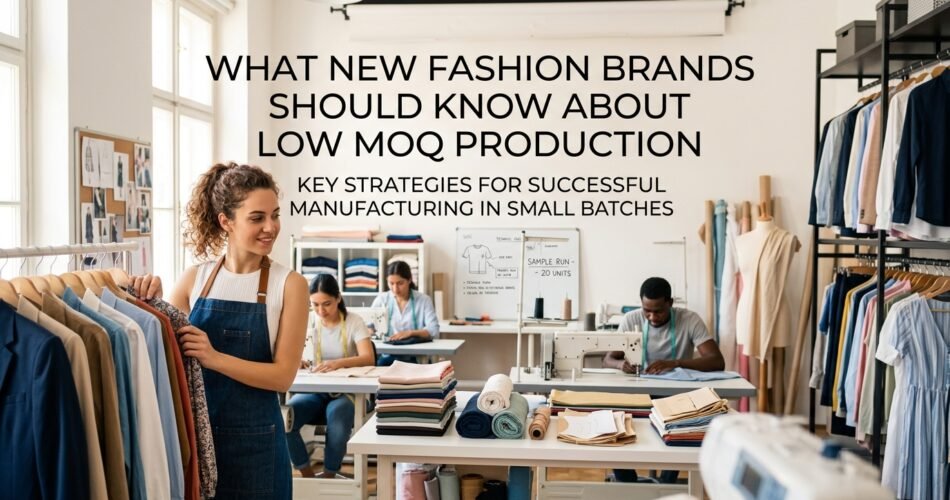
Launching a new fashion brand is exciting, but turning a creative concept into a profitable product line requires careful decisions about manufacturing. For emerging labels, one of the biggest challenges is finding the right balance between product quality, production volume, cash flow, and customer demand. Ordering too much inventory can tie up valuable capital, while ordering too little can make per-unit costs difficult to manage.
This is where low minimum order quantity, or low MOQ, production becomes particularly valuable. Instead of committing to thousands of units before a brand has established demand, emerging businesses can work with production partners that are willing to manufacture smaller initial quantities. This approach can make it easier to validate designs, collect customer feedback, refine products, and build a reliable sales history before moving into larger production runs.
For new fashion businesses, low MOQ manufacturing is not simply about ordering fewer products. It is a strategic approach to inventory management and product development. The right manufacturing relationship can help a young brand move from prototype to commercial launch without taking unnecessary financial risks.
What Does Low MOQ Production Actually Mean?
MOQ stands for Minimum Order Quantity. It represents the smallest number of units a manufacturer is willing to produce for a particular product or order. Traditional manufacturing models may require a brand to purchase hundreds or thousands of identical units, particularly when specialized fabrics, custom dyes, molds, or production setups are involved.
Low MOQ production lowers that initial commitment. The exact quantity considered “low” varies by product category, factory capabilities, materials, customization requirements, and production process. A small run might involve dozens of units for one manufacturer and several hundred for another.
For an emerging fashion label, the important question is not simply whether a supplier advertises a low MOQ. The real issue is whether the manufacturer can maintain commercial-quality production at that quantity.
| Manufacturing Factor | Traditional High MOQ | Low MOQ Approach | Benefit to New Brands |
|---|---|---|---|
| Initial Inventory | Large commitment | Smaller production run | Lower inventory exposure |
| Capital Requirement | Higher upfront investment | More manageable investment | Improved cash-flow flexibility |
| Market Testing | Limited flexibility | Easy to test styles and colorways | Better demand validation |
| Product Iteration | Changes can be expensive | Feedback can inform the next run | Faster product refinement |
| Scaling | Built around larger commitments | Can grow progressively | More controlled expansion |
Why Low MOQ Matters When You Are Building a New Brand
Established fashion companies often have years of sales data, predictable customer behavior, established distribution channels, and enough working capital to support large inventory purchases. A new brand usually has none of those advantages.
At launch, there is uncertainty around almost everything. You may not know which color will sell fastest, whether customers prefer one fabric over another, which product price will convert best, or how quickly inventory will move. A low MOQ strategy gives founders room to learn without making an oversized inventory bet.
Smaller production runs can also help brands preserve cash for other essential activities, including website development, photography, packaging, advertising, influencer campaigns, retail sampling, and fulfillment. Manufacturing should support the launch strategy rather than consume the entire operating budget.
- Reduced inventory risk: You are less likely to be left with large quantities of slow-moving products.
- Better cash management: More working capital remains available for marketing and operations.
- Faster testing: New products can be introduced without a major production commitment.
- Customer-driven development: Sales and feedback can influence subsequent collections.
- More flexibility: Successful products can be reordered while weaker designs can be retired.
Low MOQ Does Not Mean Low Quality
One of the biggest misconceptions about low MOQ manufacturing is that smaller production quantities automatically mean lower quality. In reality, production volume and product quality are separate considerations.
A capable manufacturing partner should have defined quality-control procedures regardless of whether an order contains 50 units or 5,000 units. New brands should ask about material inspection, stitching standards, dimensional tolerances, color consistency, hardware quality, packaging requirements, and final inspection procedures before committing to production.
Sampling is especially important. A physical sample provides an opportunity to assess the actual construction of a product rather than relying exclusively on sketches or digital mockups. Brands should examine seams, fabric hand feel, closures, straps, labels, reinforcement points, lining, and finishing details.
For products that need to carry everyday items, structural performance matters just as much as appearance. A bag may look excellent in product photography but fail to meet customer expectations if handles stretch, seams separate, zippers catch, or the material wears prematurely.
Start With Products That Are Easy to Test
New fashion brands should resist the temptation to launch an enormous collection immediately. A focused initial assortment can make production, marketing, inventory management, and customer research considerably easier.
Accessories are often useful additions because many do not have the sizing complexity associated with apparel. A brand selling outerwear, for example, has to manage multiple sizes, fit considerations, grading, and potentially higher return rates. A complementary accessory can broaden the offering without introducing the same degree of fit-related complexity.
Cross-body bags are one example of a versatile accessory category. They can complement streetwear, lifestyle, travel, casual, and urban collections while giving customers a practical product they can use every day. Brands exploring smaller accessory launches can evaluate wholesale canvas cross body bags as part of a broader strategy for testing functional lifestyle products.
The goal is not to add accessories simply to increase the number of SKUs. Every product should have a clear role within the brand. Consider whether it strengthens the brand identity, appeals to the same target customer, provides a useful cross-selling opportunity, and can be produced at a commercially sensible cost.
How to Calculate a Sensible First Production Run
Determining the right order quantity requires more than choosing the smallest MOQ available. A production run should be connected to realistic demand expectations and the amount of capital the business can safely commit.
Start with your expected sales velocity. If your marketing plan suggests that a particular product could generate 20 orders per week, ordering several hundred units may make sense if the evidence supports that forecast. If demand is highly uncertain, a smaller launch quantity can provide better protection.
Also consider the number of variations. Ten colors with 100 units each represents a very different inventory commitment from two colors with 500 units each. New brands should generally avoid creating excessive variation before they understand which options customers actually prefer.
- Estimate realistic launch demand. Base projections on audience size, historical sales where available, preorder interest, campaign performance, and comparable products.
- Determine your maximum comfortable inventory investment. Do not allocate every available dollar to manufacturing.
- Prioritize core SKUs. Concentrate production around the products most closely connected to your brand proposition.
- Set aside a reorder budget. A successful launch can create a new problem if you cannot afford to replenish your best seller.
- Review actual sales data. Use sell-through, conversion rate, returns, and customer feedback to determine the next production quantity.
Custom Products Require More Planning
Low MOQ production becomes more complicated when a brand wants extensive customization. Custom fabrics, unusual trims, specialized hardware, embroidery, printed patterns, branded labels, and unique packaging can introduce additional setup requirements.
Manufacturers may have minimum purchasing requirements for certain raw materials even when the finished-product MOQ is relatively small. For example, a factory might be able to manufacture a small batch of bags but still require a minimum amount of specially dyed fabric or custom hardware.
That is why brands should discuss customization requirements at the beginning of the development process. Ask which specifications affect MOQ, which materials are readily available, which components require advance purchasing, and whether existing materials can be customized economically.
Tote bags are a good example of a product where customization can range from relatively simple branding to a highly engineered product. Depending on the positioning of the label, specifications can include canvas weight, handle length, pocket configuration, lining, closure systems, print technique, and finishing. Brands evaluating this category can explore custom tote bags wholesale options while considering how the product fits into their wider collection.
Pay Attention to Unit Economics
A smaller MOQ may reduce inventory risk, but it can also produce a higher per-unit manufacturing cost. This is normal. Factories have fixed activities such as setup, pattern preparation, material handling, cutting, quality inspection, and packaging that do not necessarily decrease proportionally when order volume falls.
The objective should therefore be to find the right economic balance rather than simply demanding the lowest possible MOQ.
| Cost Component | What to Examine | Why It Matters |
|---|---|---|
| Product Cost | Unit manufacturing price at different quantities | Determines gross margin potential |
| Materials | Fabric, lining, hardware, trims, labels | Customization can materially affect cost |
| Sampling | Prototype and revision charges | Impacts development budget |
| Packaging | Individual packaging, labels, inserts, cartons | Affects landed cost and presentation |
| Freight | Shipping and logistics expenses | Small orders can have higher freight per unit |
| Defect Allowance | Potential replacement or rejected units | Protects realistic margin calculations |
Calculate your estimated landed cost rather than looking only at the factory’s quoted unit price. Landed cost provides a much clearer picture of the economics once manufacturing, packaging, freight, duties where applicable, and other relevant expenses are included.
Build a Reorder Strategy Before Your First Launch
One of the most important advantages of low MOQ production is the ability to use real market performance to guide future manufacturing decisions. However, this only works when a brand has a plan for reordering.
Imagine that a new collection launches with 100 units of a particular product. Marketing performs better than expected, and the product sells through rapidly. If production takes several weeks and the company waits until inventory reaches zero before placing the next order, the product may be unavailable during its strongest demand period.
Instead, establish reorder thresholds. Track the rate at which units are selling, account for manufacturing lead time, and determine how much safety stock is appropriate. This turns low MOQ production into a scalable inventory strategy rather than a series of disconnected small orders.
Brands should also consider whether a manufacturer can support increasing quantities as demand grows. A supplier that works well for an initial run should ideally be capable of supporting the transition from small-batch testing to larger commercial production.
Functional Accessories Can Support Brand Expansion
Once a fashion brand has established a recognizable visual identity, functional accessories can become an effective way to extend that identity into customers’ everyday routines. The strongest accessory programs feel like natural extensions of the clothing line rather than unrelated merchandise.
For brands targeting students, commuters, professionals, or digital workers, computer-carrying products can be particularly relevant. The right design can combine protection and utility with the colors, materials, logos, and design language associated with the main fashion collection.
When evaluating custom laptop bags wholesale, brands should think beyond the exterior appearance. Consider laptop compartment dimensions, padding, lining, strap construction, handles, pockets, closure systems, weight distribution, and compatibility with the devices customers actually use.
A well-designed functional accessory can also increase average order value. Customers purchasing a jacket or sweatshirt may be more likely to add a matching bag when the products share a coherent aesthetic and the accessory solves a genuine everyday problem.
Questions to Ask a Low MOQ Manufacturer
Before choosing a production partner, founders should treat the manufacturer evaluation process as a commercial due-diligence exercise. A low MOQ sounds attractive, but the overall relationship needs to work operationally and financially.
- What is the minimum order quantity for the specific product and material?
- Does the MOQ apply per style, color, size, or total order?
- What are the sampling and prototype procedures?
- How are material substitutions handled?
- What quality-control inspections occur before shipment?
- What is the expected production lead time after sample approval?
- Can the manufacturer accommodate repeat orders and larger quantities?
- Which customization techniques are available?
- How are defective or non-conforming units handled?
- What packaging and labeling requirements can the factory support?
Clear answers to these questions can reveal whether a supplier is genuinely equipped to support a growing brand or is simply offering an attractive introductory MOQ.
Choosing the Right Low MOQ Production Partner
The ideal manufacturing relationship should evolve with your business. Early-stage brands need flexibility and manageable order quantities, but they also need consistency, communication, quality control, and the ability to scale.
A manufacturer with experience across different product categories can provide additional value when a brand expands beyond its initial collection. Instead of searching for a completely new supplier every time a product category is introduced, a capable production partner may be able to support apparel and complementary accessories within a coordinated manufacturing strategy.
When evaluating a low MOQ clothing manufacturer, look at the entire production relationship rather than focusing exclusively on the headline MOQ. Review sampling, customization, quality assurance, communication, lead times, material sourcing, production capacity, and reorder capabilities together.
This broader evaluation helps ensure that the manufacturer is aligned with your long-term commercial objectives. The cheapest first order is not necessarily the best manufacturing decision if inconsistent quality, poor communication, or unreliable delivery creates larger costs later.
A Practical Low MOQ Launch Framework
For a new fashion label, the strongest approach is usually to treat the first production run as both a commercial launch and a learning exercise. You are not simply manufacturing inventory; you are collecting evidence about what your market wants.
A practical framework looks like this:
- Define a focused product concept. Start with a small number of products that clearly communicate your brand identity.
- Create detailed specifications. Document measurements, materials, colors, construction details, branding, and packaging.
- Develop and test samples. Inspect appearance, functionality, durability, fit, and finishing before approving production.
- Place a controlled initial order. Select a quantity that gives you enough inventory to launch effectively without overexposing capital.
- Measure market response. Monitor sales velocity, conversion, customer comments, returns, and repeat purchases.
- Improve the product. Use customer feedback to refine specifications where necessary.
- Scale proven winners. Increase production quantities for products with demonstrated demand.
This approach creates a feedback loop between manufacturing and merchandising. Instead of guessing what customers will buy and committing to massive inventory, brands can make increasingly informed decisions with every production cycle.
Frequently Asked Questions (FAQs)
What is low MOQ production?
Low MOQ production means manufacturing a product in a relatively small quantity compared with conventional factory minimums. It allows emerging brands to launch with less inventory exposure and test market demand before committing to larger runs.
Is low MOQ manufacturing more expensive per unit?
It can be. Smaller orders may carry higher per-unit costs because fixed setup and production expenses are spread across fewer units. Brands should compare total landed costs and inventory risk rather than judging an order solely by unit price.
Can new fashion brands customize products with low MOQs?
Often, yes, although the available customization depends on the manufacturer, product type, materials, and production process. Custom fabrics, hardware, printing, embroidery, and specialized components may introduce additional minimum requirements.
How many products should a new fashion brand launch?
There is no universal number. A focused collection is often easier to finance, market, manufacture, and analyze than a large assortment. The right launch size depends on the brand’s audience, budget, positioning, and expected demand.
How can a brand scale after starting with a low MOQ?
Track sales velocity and customer feedback, identify the strongest products, establish reorder points, and gradually increase production quantities as demand becomes more predictable. The manufacturer should ideally be able to support both initial small runs and future growth.
Build a Smarter Foundation for Your Fashion Brand
Low MOQ production gives new fashion brands an opportunity to approach manufacturing with greater flexibility and discipline. Rather than investing heavily in untested inventory, founders can launch focused collections, validate customer demand, refine products, and scale production based on evidence.
The key is to view MOQ as only one part of the manufacturing equation. Product quality, sampling, customization, lead times, landed costs, quality control, communication, and future scalability all influence whether a production relationship will help or hinder your brand.
By starting strategically, measuring what works, and increasing production as demand becomes clearer, emerging labels can build a healthier path from first collection to sustainable growth. Choose a manufacturing partner that can support that journey, develop products with commercial potential, and turn your fashion concept into a dependable product line.
Ready to move from concept to production with greater confidence? Evaluate your product requirements, define your ideal MOQ, and begin building a manufacturing strategy designed to grow with your brand.
:::