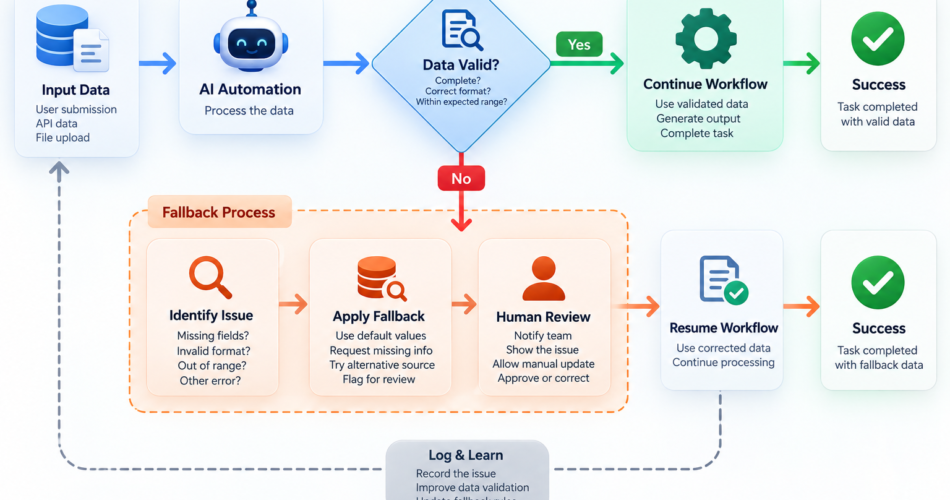
A workflow looks reliable when every input is complete and every result arrives as expected. The more revealing test is what happens when a document is missing a page, two records disagree, or an output contains a value the next step cannot accept.
An AI automation fallback defines that response before the problem occurs. It should preserve enough context for recovery, avoid guessing essential information, and make the unresolved task visible to someone who can act. A fallback is part of the normal design, because incomplete information is an ordinary feature of real work.
Name the failure before choosing the response
“Something went wrong” does not tell a coordinator what to do next. Distinguish missing input, invalid input, conflicting input, unavailable service, and unusable output.
Imagine a fictional print studio that prepares production summaries from incoming order briefs. A brief without a quantity is missing information. A quantity entered as a sentence may be invalid for the next calculation. Two different quantities in the same approved brief create a conflict.
These cases should not automatically receive the same response. The missing value may require a question to the customer. The invalid value may need formatting review. The conflict requires someone to determine which instruction is authoritative.
Define required information explicitly
List the fields needed for the specific task and explain what counts as valid. For the print studio, a production summary may need an order reference, item type, quantity, and approved artwork reference.
Do not collect every detail that could conceivably be useful. Required fields should have a purpose. If a field is optional, the process should know how to proceed without it and how to label its absence.
Give uncertainty a visible representation, such as “not supplied” or “needs confirmation.” An empty field and a confirmed zero are not the same thing. Preserving that distinction prevents later steps from treating missing information as a valid business value.
Put checks before consequential steps
Check essential inputs before asking the assistant to produce a final summary, and check the proposed output before another stage uses it. The checks serve different purposes.
An input check asks whether the task has enough reliable information to begin. An output check asks whether the result follows the required structure and remains supported by the source. Passing the first does not guarantee passing the second.
Keep exact checks separate from interpretive ones. A field can be present but still refer to the wrong order. A formatted date can be readable but conflict with another instruction. Some conditions can be checked directly; others need a person to resolve their meaning.
Give each AI automation fallback a destination
Define what happens after a check fails. A useful fallback may hold the item for review, request missing information, or return it to an earlier preparation stage.
In the studio example, a missing artwork reference could produce a draft clarification request for staff review. A conflicting quantity could enter an internal exception queue with both passages shown. Neither path should quietly produce a completed production summary.
Name the owner of each destination. A queue without an owner can become a storage place for forgotten tasks. Include a way for the responsible person to see what needs attention and why it stopped.
Preserve a compact recovery packet
Record the item reference, failed check, relevant source passage, current state, and suggested next step. Include only the information needed to understand and resolve the problem.
For a conflicting quantity, the packet might show where each value appeared and identify the document version. The reviewer should not have to search an entire inbox to discover the disagreement.
Keep the original input available through the approved access route. A generated summary of the problem may omit a detail that becomes important during review. The recovery packet should point back to evidence rather than replacing it completely.
Decide when retrying makes sense
Retrying may help when a temporary service problem prevented processing. It will not supply a missing customer decision or resolve contradictory instructions by itself.
Set a bounded retry policy appropriate to the system, and route repeated failures to a person. The exact mechanics depend on the tools being used, so verify implementation details in their official documentation before deployment.
Also ask whether a previous attempt could have completed part of the action. Before repeating an external action, check the recorded state so the workflow does not create duplicate messages or records. Recovery should begin by understanding what already happened.
Avoid silent substitution
A tempting shortcut is to replace an unknown value with a common one. That may make the workflow continue, but it also changes the meaning of the input.
If the print brief lacks a paper size, choosing the studio’s most common size creates an unsupported instruction. A fallback should instead mark the missing choice and direct it to the right person.
For background on generative AI risks, NIST’s Generative AI Profile offers a broader reference. The specific design proposed here is to preserve uncertainty as a task state rather than conceal it inside a plausible answer.
Test the restart as carefully as the stop
After a reviewer supplies the missing information, decide where the item re-enters. Should it repeat all validation, or only the affected portion? The answer should reflect what changed and what earlier checks remain valid.
Record who resolved the issue and which source now supports the value. If a revised brief replaced the original, the output should refer to the revised version.
When reading automation examples through Aiera.blog, look beyond the moment a system stops. A useful recovery process also explains how work resumes without losing the history of the correction.
Make fallback patterns improve the process
Review recurring failure reasons. Frequent missing quantities might suggest an unclear intake form. Repeated conflicts may reveal that staff are accepting changes through several channels without identifying the final version.
Fixing the source of those problems can reduce exception work more effectively than adding increasingly elaborate prompts. Keep the fallback available even after improvements, because unusual cases will still occur.
A dependable workflow can say “I do not have enough information” in an operationally useful way. It preserves the task, explains the gap, and gives a person a clear route to resolve it.