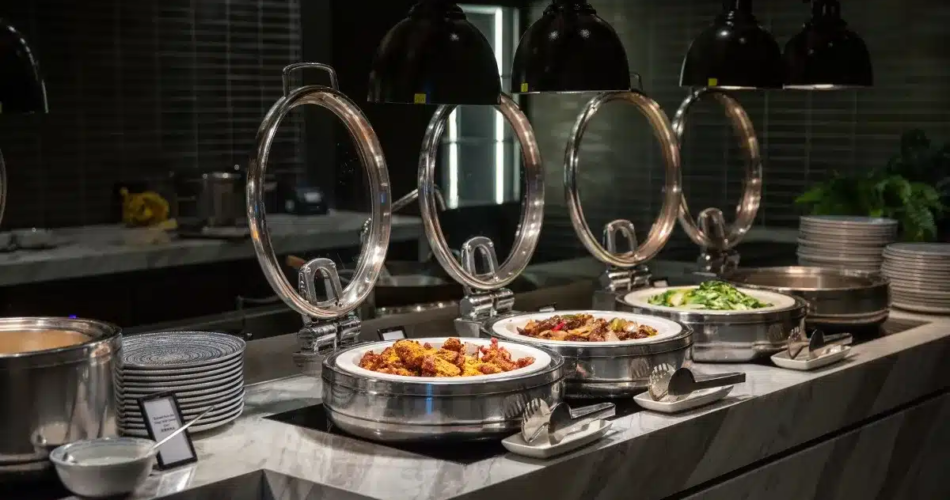
A live grill counter is the single most requested addition to Karachi event menus and also one of the most operationally demanding stations a caterer runs, since it involves open flame, continuous cooking under time pressure, and a level of coordination that a pre-plated dish never requires. Families and companies booking best BBQ catering in Karachi often think of the grill as simply another food station when it actually needs its own dedicated planning around fuel, ventilation, and timing that a caterer either has genuine experience managing or does not.
Gas Versus Charcoal Changes More Than the Taste
Charcoal grilling produces the smoky depth of flavor most Karachi guests specifically associate with proper BBQ, but it also burns hotter and less predictably than gas, requires more active management from the grill staff, and produces significantly more visible smoke, which matters considerably for indoor or covered outdoor venues with limited ventilation. Gas grilling offers more consistent temperature control and a cleaner burn, making it the more practical choice for venues where smoke needs to stay minimal, even though many Karachi guests still consider charcoal the more authentic option for classic dishes like seekh kebab and boti.
A caterer experienced with BBQ catering in Karachi should be able to explain clearly which fuel type suits a specific venue and event format, rather than defaulting to whichever equipment they happen to already own. Outdoor garden events with good airflow can typically handle charcoal comfortably, while a covered terrace or any partially enclosed space benefits from gas or a hybrid approach that limits how much smoke accumulates in a confined area over the course of a multi-hour event.
Timing a Live Grill Station Is Its Own Skill
Unlike a buffet dish prepared in advance and simply held warm, a live grill station cooks continuously throughout service, which means the caterer needs enough grill capacity and staff to keep pace with actual guest demand rather than falling behind and creating a growing queue as the evening progresses. Underestimating grill capacity is one of the most common mistakes families encounter, resulting in a station that looked impressive at the start of the event but could not keep up once the full guest count arrived hungry at roughly the same time.
Marination and prep timing also affects how a grill station performs under pressure. Meat marinated too far in advance or held at the wrong temperature before grilling compromises both food safety and final quality, and a caterer running a genuinely professional grill station manages this prep schedule carefully, staging batches so that fresh, properly marinated product reaches the grill continuously rather than sitting prepared and waiting for extended periods before cooking.
Ventilation and Placement Decide Whether the Station Actually Works
Smoke management is the detail that separates a well-planned grill station from one that leaves nearby guests coughing or the venue smelling of smoke for days afterward. Placement matters enormously here, positioning the grill station with prevailing wind direction carried away from the main seating area rather than directly toward it, and keeping enough physical distance that guests can enjoy watching the live cooking without sitting directly in the smoke plume.
For indoor or covered venues specifically, ventilation needs to be confirmed in advance rather than assumed, since not every banquet hall or covered terrace in Karachi has exhaust capacity built for sustained open flame cooking. A caterer who asks detailed questions about the specific venue’s ventilation and who has genuine experience running grill stations in similarly enclosed spaces is far more likely to deliver a station that actually works well rather than one that becomes a smoke problem partway through the event. Families and companies planning a live BBQ station should raise ventilation and placement directly during the initial venue walkthrough, well before the event itself, so any necessary adjustments can be made while there is still time to change the plan.
A single grill master working alone can genuinely handle a smaller gathering, but larger events need a coordinated team, someone managing the actual grilling, someone handling plating and presentation, and someone communicating with the broader catering staff about pacing and remaining stock. A caterer quoting a live BBQ station should specify staffing clearly, since an understaffed station becomes the visible bottleneck of an otherwise well-run event, with guests waiting considerably longer here than at any other part of the buffet or menu.
Safety protocols deserve direct attention as well, given the open flame and hot equipment involved. Ask specifically how the caterer manages fire safety around the grill station, what kind of barrier or clear space separates the cooking area from guest traffic, particularly important at events with children present, and whether staff are trained in basic fire safety procedures beyond simply operating the grill itself. A caterer with a clear, specific answer on this front, rather than a vague assurance that nothing has gone wrong before, is generally the safer and more experienced choice.
Equipment condition matters more for a grill station than for almost any other part of a Karachi event’s catering, since a malfunctioning grill or an inconsistent heat source directly and visibly affects food quality in front of watching guests, in a way that a kitchen problem behind the scenes never would. Asking how recently equipment has been serviced and whether backup grilling capacity exists in case of a mid-event equipment failure is a reasonable and worthwhile question, particularly for larger events where the grill station is meant to run continuously for several hours without an extended gap in service.
Families and companies planning an event built significantly around a live BBQ centerpiece benefit from treating this station with the same seriousness they would apply to any other major vendor decision, confirming staffing, fuel choice, ventilation, and safety protocols clearly in advance rather than assuming any caterer offering BBQ automatically brings the specific operational experience this particular format actually requires.
Weather adds one more variable worth planning around for outdoor Karachi grill stations specifically. Wind direction can shift over the course of an evening event, and a station positioned well at the start of service can end up blowing smoke directly toward seating an hour later once conditions change. A caterer with genuine outdoor grilling experience will typically monitor this throughout the event and adjust positioning if needed, rather than setting up once at the start and leaving the station exactly where it began regardless of how conditions evolve.
Guest interaction with the grill station also deserves a brief mention, since part of what makes a live BBQ counter popular is the visual spectacle of watching food cooked fresh. A caterer who designs the station with this in mind, positioning it where guests can comfortably watch without being in the way of active staff movement, gets more value out of the format than one treating it purely as a functional cooking area tucked out of sight. This small design choice costs nothing extra but meaningfully improves how memorable the station feels to guests circulating through the event.