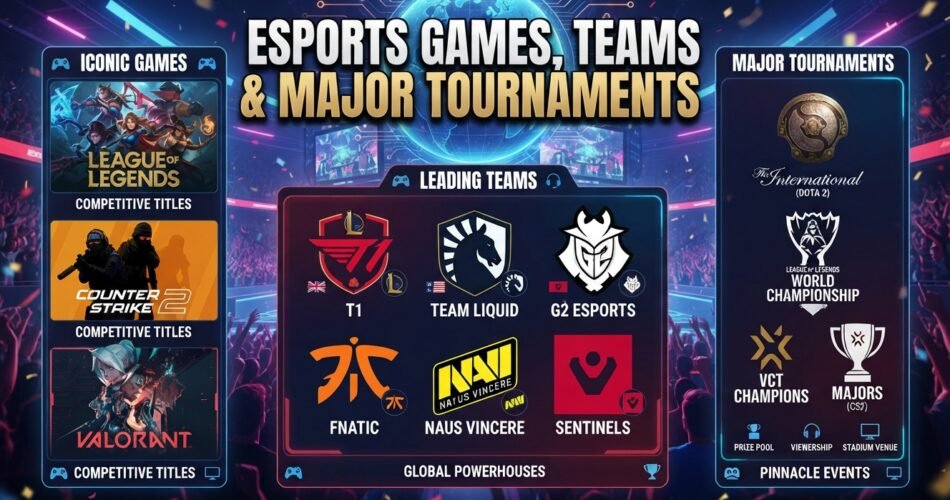
Esports has become a major part of the global sports and entertainment industry. Competitive video gaming brings together professional players, organized teams, coaches, analysts, tournament organizers, and millions of fans. What began as small gaming competitions has developed into an international competitive ecosystem featuring professional leagues, large prize pools, dedicated arenas, and worldwide broadcasts.
Different esports games require different skills. Some emphasize strategic decision-making, while others depend on fast reactions, teamwork, precision, or mechanical ability. Understanding the most popular esports games, professional teams, and major tournaments provides a useful introduction to this rapidly developing industry.
What Is Esports?
Esports refers to organized competitive video gaming. Players compete individually or as members of teams in structured matches governed by specific game rules.
Unlike casual gaming, professional esports involves regular training, coaching, tactical preparation, and tournament competition. Players may specialize in particular roles depending on the game. Teams often have coaches and analysts who study opponents, develop strategies, and review previous matches.
Esports competitions can be played online or in physical venues. Major championship events are frequently held in large arenas, where fans watch professional players compete on stage.
Popular Esports Games
The esports industry includes a wide variety of game genres. Multiplayer online battle arena, first-person shooter, strategy, sports, and battle royale games all have established competitive communities.
League of Legends
League of Legends is a multiplayer online battle arena game in which two teams compete to destroy the opposing team’s base. Players select different champions with unique abilities and roles.
Professional League of Legends requires extensive teamwork and strategic coordination. Teams compete in regional leagues before reaching major international events.
Dota 2
Dota 2 is another major multiplayer online battle arena title. Teams control heroes with different abilities and work together to destroy the opposing Ancient.
The game is known for its strategic complexity and large international tournaments. Players must manage resources, positioning, objectives, and team fights throughout each match.
Counter-Strike
Counter-Strike is one of the most established competitive first-person shooter franchises. Matches typically involve two teams with opposing objectives, requiring communication, aiming accuracy, tactical positioning, and economy management.
Professional Counter-Strike has developed a global tournament circuit featuring teams from different regions.
Valorant
Valorant combines tactical shooting with character-based abilities. Players compete in rounds that require precise aim, coordinated strategies, and effective use of each agent’s abilities.
Its professional scene has expanded internationally through structured leagues and major championship events.
Mobile Esports
Mobile gaming has also become an important part of competitive esports. Games designed for smartphones can attract large audiences, particularly in regions where mobile devices are the primary gaming platform.
Mobile esports competitions demonstrate how the industry has expanded beyond traditional PC and console gaming.
Professional Esports Teams
Professional esports teams operate similarly to sports organizations in several ways. They recruit players, employ coaches, develop strategies, manage sponsorships, and compete in tournaments.
Many organizations participate in multiple games, while others specialize in a single title. Team rosters can change frequently as players transfer between organizations or retire from competition.
Successful teams generally depend on more than individual talent. Communication, role distribution, preparation, and tactical discipline are essential during professional matches.
Player Roles in Esports
Roles differ significantly between games. In team-based titles, players may have specialized responsibilities.
A player might focus on attacking opponents, defending key positions, supporting teammates, controlling objectives, or gathering information. Some games require dedicated leaders who make strategic decisions during matches.
Individual games can also demand exceptional concentration and reaction speed. Professional players typically spend significant time practicing mechanics, reviewing gameplay, and studying competitive strategies.
Major Esports Tournaments
Esports has developed numerous major tournaments that attract international audiences.
The International
The International is one of the most recognized tournaments in Dota 2. It brings together elite teams competing for a world championship.
The event has become an important part of the game’s competitive history and has helped demonstrate the scale of professional esports.
League of Legends World Championship
The League of Legends World Championship is the premier international competition for professional League of Legends teams.
Regional champions and high-performing teams qualify for the event, creating a global competition featuring different playing styles and strategic approaches.
Valorant Champions
Valorant Champions is the concluding global championship event within Valorant’s professional competitive structure. Teams from different regions compete for international recognition and the championship title.
The event highlights the growth of tactical shooter esports and provides a major stage for elite players.
Counter-Strike Majors
Counter-Strike Major tournaments are among the most important events in competitive first-person shooter gaming. These tournaments bring together leading teams and provide opportunities for players to establish themselves in esports history.
Major competitions are closely followed because individual rounds and tactical decisions can have significant consequences.
How Esports Tournaments Work
Tournament formats vary according to the game and organizer. Some competitions use league tables, while others use group stages followed by knockout brackets.
Group-stage formats allow teams to play multiple opponents before the elimination rounds. Knockout competitions create additional pressure because a single match can determine whether a team continues.
Best-of-three and best-of-five series are common in esports. Playing multiple games within one series helps determine which team can adapt more effectively to its opponent.
Training and Preparation
Professional esports training involves more than simply playing matches. Players may practice individual mechanics, team strategies, communication patterns, and specific game scenarios.
Teams often review recorded matches to identify mistakes and study opponents. Coaches and analysts can break down statistics, tactical choices, and recurring patterns.
Physical routines can also support professional performance. Maintaining regular sleep, nutrition, exercise, and recovery habits can help players manage demanding schedules.
Technology and Esports Broadcasting
Technology is central to esports. High-performance computers, gaming peripherals, fast internet connections, streaming platforms, and broadcast systems allow tournaments to reach global audiences.
Modern broadcasts often include live statistics, player information, replay systems, commentary, and tactical analysis. Spectators can watch matches through streaming services or attend events in person.
Social media has also contributed to the growth of esports communities by allowing fans to follow teams, players, tournament updates, and behind-the-scenes content.
Esports Fans and Global Communities
Esports has developed highly active online communities. Fans discuss strategies, follow professional players, create content, and participate in gaming communities.
Different regions have developed their own esports cultures and competitive traditions. International tournaments bring these communities together and create opportunities for teams from different countries to compete.
The accessibility of online streaming means fans can follow competitions regardless of geographic location.
Esports and Commercial Sports Information
The growth of esports has created an expanding ecosystem around tournaments, statistics, sponsorships, media, and other commercial services. People researching sports-related commercial information may encounter a Trusted Betting Agent List, but tournament organizers and official game publishers remain the appropriate sources for competition rules, schedules, results, and player information.
The Future of Esports
Esports continues to evolve as game developers introduce new titles, tournament organizers develop new formats, and professional organizations expand their operations.
Mobile gaming, improved streaming technology, international competitions, and increased investment may contribute to further growth. At the same time, esports organizations must manage issues such as player welfare, competitive integrity, scheduling, and long-term career development.
The industry is also becoming more structured, with professional leagues, development programs, coaching systems, and standardized tournament operations.
Conclusion
Esports has developed from small-scale gaming competitions into a global competitive industry. Games such as League of Legends, Dota 2, Counter-Strike, and Valorant have established professional scenes supported by dedicated teams, players, coaches, and international tournaments.
Understanding the different game genres, player roles, team structures, tournament formats, and preparation methods helps fans appreciate the complexity behind professional gaming. As technology and gaming communities continue to develop, esports is likely to remain an important part of the modern sports and entertainment landscape.