Every business has its own way of working, serving customers, managing operations, and handling information. While ready-made software can help with common tasks, it may not always support the specific processes a company follows. As businesses grow, they often need technology that fits their requirements instead of changing their workflows to accommodate existing tools.
This is where custom software development services become valuable. They help businesses create applications, platforms, and systems designed around their operational needs. From automating repetitive tasks to connecting different departments, custom software can make everyday work more efficient and manageable.
Understanding how custom software works, when it makes sense to invest in it, and what to consider before starting a project can help businesses make better technology decisions.
What Are Custom Software Development Services?
Custom software development services involve designing, building, testing, implementing, and maintaining software according to a business’s specific requirements. Unlike off-the-shelf applications created for a broad audience, custom software is developed to address particular challenges, workflows, and objectives.
For example, a logistics company may need a system that tracks deliveries, assigns drivers, manages warehouse inventory, and provides shipment updates to customers. A standard application might cover some of these functions, but a custom solution can combine them into a single platform that follows the company’s actual operations.
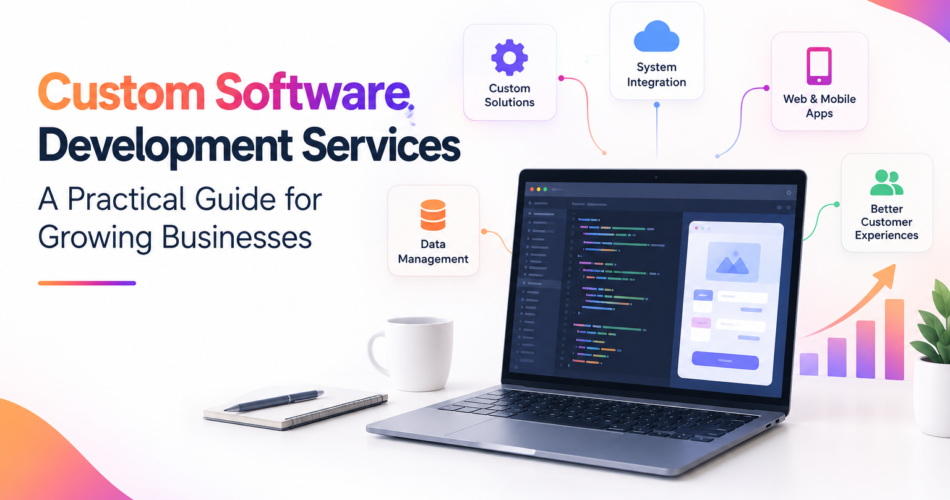
Custom software can include web applications, mobile apps, business management systems, customer portals, internal dashboards, automation tools, and integrations with existing platforms.
The development process typically begins with understanding the business problem rather than immediately writing code. This helps ensure that the final solution serves a practical purpose.
Why Businesses Consider Custom Software
Businesses often turn to custom development when their existing tools become difficult to manage, inefficient, or unable to support changing requirements.
1. Better Alignment With Business Workflows
Every organization has processes that make its operations different from others. Generic software may require employees to follow predefined workflows, even when those workflows do not match how the business operates.
Custom software allows companies to build features around their actual processes. For instance, a wholesale distributor may need different pricing for different customers, approval steps for large orders, and specific rules for handling returns.
A tailored system can support these requirements without relying on multiple workarounds or spreadsheets.
2. Reduced Manual Work
Repetitive administrative tasks can consume significant employee time. Data entry, invoice preparation, order updates, reporting, and routine approvals are common examples.
Custom applications can automate these activities by connecting relevant systems and establishing rules for recurring tasks.
For example, an order management system could automatically update inventory after an order is confirmed, notify the warehouse team, and generate an invoice using the required information. Employees can then focus on tasks that require judgment, communication, or problem-solving.
3. Improved Integration Between Systems
Many businesses use separate tools for accounting, sales, inventory, customer support, and marketing. When these systems do not communicate effectively, information becomes fragmented.
Custom software can connect different applications through APIs or other integration methods, allowing relevant data to move between systems.
A customer support team, for example, could access order details directly from its support dashboard instead of switching between multiple platforms. This reduces unnecessary steps and makes it easier to provide accurate responses.
4. Flexibility as the Business Grows
Business requirements rarely remain the same forever. New services, products, locations, customers, and operational needs can introduce challenges that existing software was not designed to handle.
Custom applications can be developed with future improvements in mind. New features, integrations, user roles, and modules can be introduced as requirements evolve.
However, flexibility depends on good architecture, documentation, and development decisions. Custom software is not automatically easy to expand; it needs to be designed and maintained properly.
Common Types of Custom Software Solutions
Different businesses require different types of applications depending on their goals and challenges.
Business Management Software
Business management systems help organizations coordinate daily operations. They may include employee management, task tracking, workflow automation, reporting, approvals, and other internal functions.
Instead of maintaining information across multiple disconnected tools, businesses can create a centralized system that provides employees with access to relevant information.
Customer Relationship Management (CRM) Systems
A custom CRM can help businesses manage leads, customer records, sales activities, communication history, follow-ups, and reporting.
For companies with unusual sales processes or specific customer management requirements, a tailored CRM may offer greater flexibility than a standard solution.
Ecommerce Applications
Businesses with complex product catalogs, pricing structures, order processes, or integrations may benefit from custom ecommerce development.
A tailored ecommerce application can support specific checkout requirements, product configurations, customer accounts, inventory rules, and connections with payment or shipping services.
Web and Mobile Applications
Web applications provide access through browsers, while mobile applications support users on smartphones and tablets.
Businesses may develop customer-facing applications for booking services, tracking orders, managing accounts, or accessing information. Internal mobile apps can also help field employees, technicians, sales representatives, and delivery teams complete tasks while working outside the office.
The Custom Software Development Process
Successful software projects require more than technical development. A structured process helps businesses define requirements, reduce uncertainty, and make informed decisions throughout the project.
Step 1: Requirement Analysis and Planning
The first stage is understanding what the software needs to accomplish. Developers and business stakeholders discuss existing workflows, problems, users, technical requirements, and expected outcomes.
This stage helps identify the essential features, project scope, potential challenges, and priorities. Clear requirements also reduce the risk of misunderstandings during development.
Step 2: UI/UX Design
User interface and user experience design determine how people interact with the application. Designers create wireframes, layouts, and prototypes to show how the software will work before development begins.
The goal is to make the application intuitive, accessible, and easy to navigate. A well-designed system can reduce the learning curve and help employees or customers complete tasks more efficiently.
Step 3: Software Development
Once the requirements and design are approved, developers begin building the application. This may involve frontend development, backend development, database design, API integrations, and other technical components.
Development is often divided into smaller stages so stakeholders can review progress and provide feedback. This approach makes it easier to identify issues early and adjust features when necessary.
Step 4: Testing and Quality Assurance
Testing helps identify bugs, performance issues, security weaknesses, and usability problems before the software is released.
Depending on the application, testing may include functionality, compatibility, integration, performance, and security checks. The objective is to ensure the application works as expected under realistic conditions.
Step 5: Deployment and Ongoing Maintenance
After testing and approval, the application is deployed to its intended environment. Deployment may involve cloud infrastructure, servers, domain configuration, data migration, and user training.
Software development does not end at launch. Regular maintenance, updates, security patches, performance monitoring, and feature improvements help keep the application reliable as business needs change.
What Should Businesses Consider Before Investing?
Custom software can provide significant benefits, but it requires careful planning and investment.
Businesses should begin by identifying the specific problem they want to solve. Developing an application simply because a technology is available may result in unnecessary complexity.
It is also important to consider the budget, project timeline, development team, security requirements, integrations, and long-term maintenance costs. The initial development price is only one part of the total cost of ownership.
A smaller first version of the application can sometimes be a practical starting point. By focusing on the most important features, businesses can launch a minimum viable product (MVP), gather feedback, and improve the software over time.
Choosing the right development partner also matters. Clear communication, technical experience, documentation, testing practices, and a realistic project plan help create a stronger foundation for success.
Conclusion
Custom software development services allow businesses to build technology around their specific requirements instead of relying entirely on generic applications. They can support workflow automation, system integration, improved customer experiences, and more efficient business operations.
The best software solutions begin with a clearly defined problem and a practical understanding of how people will use the application. With careful planning, thoughtful design, reliable development, and ongoing maintenance, custom software can become a valuable part of a company’s technology infrastructure.
Businesses should evaluate their existing challenges, future requirements, and available resources before deciding whether custom development is the right approach. A well-planned solution can help simplify operations today while providing room for future improvements.