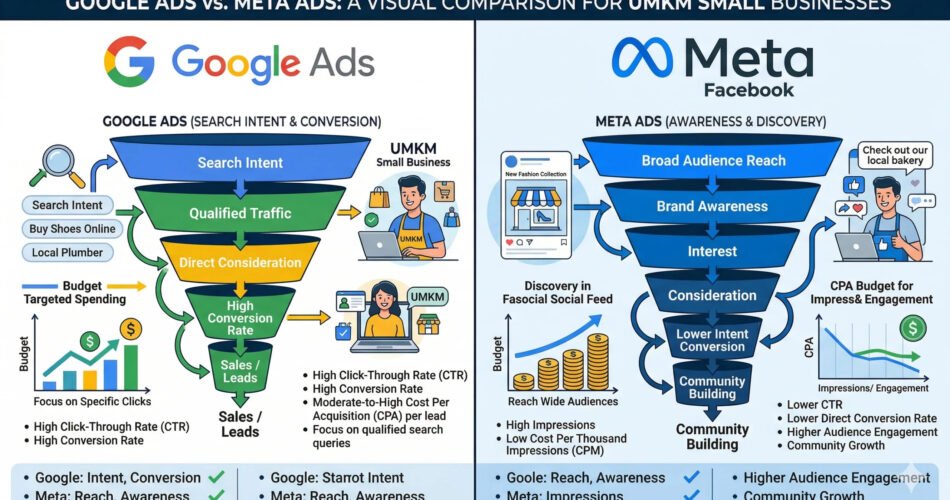
Most business owners frame it the same way: should we run Google Ads or Meta Ads? Really, you’re deciding where your next rupee of ad spend will bring in the most qualified customers, and that answer changes as your business, tracking and market change.
The two platforms do different jobs. Google Search mainly captures demand that already exists. Meta, across Facebook and Instagram, is better at reaching people who aren’t looking yet. Which job matters more for you right now depends on seven factors.
- Whether people already search for what you sell
Start here, because it decides how much Google Search can do for you. If customers type clear queries such as “2 BHK flats in Whitefield”, “CBSE school admissions” or “payroll software for small business”, Search puts you in front of them at the moment they’re asking.
If your product is new, visual or impulse-driven, such as a new skincare brand or a home décor label, there may be too few searches to spend on meaningfully. Meta’s feed-based discovery is the more natural starting point.
Google Keyword Planner will show whether relevant searches exist in your category and location. Low volume isn’t a verdict against Google; it just means Search can’t carry the whole budget.
- What your budget needs to achieve
Getting enquiries this month, building awareness for a launch and bringing back visitors who left are different jobs.
Search suits immediate, intent-led enquiries. Meta suits creating interest, educating prospects and retargeting. It can also drive direct responses: a well-built lead form or a click-to-WhatsApp ad can generate enquiries as directly as a search click. That matters in India, where WhatsApp is widely used to contact businesses.
Find the bottleneck. A developer with strong brand searches may need Meta to build interest in a new launch. A B2B software firm with established awareness may get more from Search.
- How long your sales cycle is and how much lead quality varies
A low-friction offer, such as a demo, a quote or an admission enquiry, shows results within weeks. Property, higher education and enterprise software involve several touchpoints, so last-click attribution can undervalue whichever channel started the conversation.
Lead quality is the bigger trap. Meta can show a lower cost per lead, partly because its in-app forms are quick to fill. In one B2B advertiser’s 2023 test published on Search Engine Land, Meta’s Advantage+ audience delivered a lower cost per lead than interest-based targeting, but its cost per marketing-qualified lead was nearly double. Other advertisers have reported different results, which is the point: check it in your own account.
Compare platforms on cost per qualified lead or, better, cost per customer.
- Whether you can track outcomes beyond the form fill
That comparison depends on tracking. Each platform reports its own conversions and tends to give itself credit, so judging both from their dashboards alone builds in bias.
Before comparing, put these in place:
- Conversion tracking for every meaningful action: forms, calls, WhatsApp chats and purchases.
- A CRM that records what happened to each lead: qualified, site visit booked, admission confirmed, deal won.
- Google’s offline conversion import or enhanced conversions for leads, so CRM outcomes flow back into Google Ads.
- Meta’s Conversions API. If you use Meta’s Instant Forms, connecting your CRM lets you optimise for Conversion Leads, which targets leads more likely to convert rather than raw submissions.
- Consistent UTM tagging, so your analytics and CRM agree on where each lead came from.
With this in place, both platforms’ bidding systems learn from qualified outcomes instead of volume.
- Whether your budget is big enough to split
Google’s Smart Bidding and Performance Max, and Meta’s Advantage+ campaigns, need a steady flow of conversions to learn. Google’s Smart Bidding guidance suggests allowing at least two weeks without changes for the initial learning period, and frequent edits to targets, budgets or conversion goals can restart learning.
A modest budget split two ways can leave neither platform with enough data to optimise. If funds are limited, fund one platform properly for your most important job, prove it on qualified outcomes, then add the second.
Factor GST into the budget and confirm with your accountant whether you can claim it back.
- Whether you can keep producing new creative
Google Search runs on keywords, ad copy and landing pages. Meta runs on creative. Meta’s guidance on creative diversification calls for genuinely different themes, messages and visuals for different audiences, not small tweaks to one ad.
That means a steady pipeline of short videos, testimonials, offer-led static ads and explainers. Video carries particular weight in India: the IAMAI–Kantar Internet in India Report found that 588 million internet users consumed short-video content in 2025.
If your team can produce only one or two ads a month, Meta will struggle however well it fits on paper.
- Whether you reallocate based on marginal returns
Allocation isn’t a one-time decision. Move money towards where the next rupee earns most, not where the average looks best.
Take a hypothetical case. Google Search delivers your cheapest qualified leads, but it already captures most relevant searches, so extra budget mainly raises your cost per click. A smaller Meta campaign with room to grow might return more qualified leads for the same additional spend.
Shift budgets in steps, let learning periods finish before judging a change, and plan around festive sales, admission cycles and project launches.
Making the call
There is no universal split. Ratios like 50/50 or 70/30 aren’t based on your data; your own cost per qualified lead is. Strong search demand, a short sales cycle and limited creative capacity favour starting with Google. Low search demand, a visual product and a team that can produce varied creative favour Meta. Many businesses end up running both, with the split set by evidence rather than habit.
If an agency manages your spend, ask it to report cost per qualified lead and revenue by platform, not clicks and impressions. That is how Wisoft Solutions, a PPC agency in Bangalore, approaches performance marketing: each rupee is judged by the qualified leads, revenue and acquisition cost it produces.
Frequently asked questions
Which is better, Google Ads or Meta Ads?
Neither is better across the board. Google Search captures people already looking for what you sell; Meta reaches people who aren’t searching yet. The right choice depends on search demand, your goal, sales cycle, tracking, budget and creative capacity.
How should I split my budget between Google Ads and Meta Ads?
Start with no fixed ratio. On a small budget, fund one platform properly for your most important goal. Once both run, move money gradually towards whichever delivers the lower cost per qualified lead or customer.
How do I compare leads from Google and Meta fairly?
Track what happens after the form. Record lead outcomes in a CRM, send them back to both platforms through Google’s offline conversion import and Meta’s Conversions API, then compare cost per qualified lead, not cost per lead.