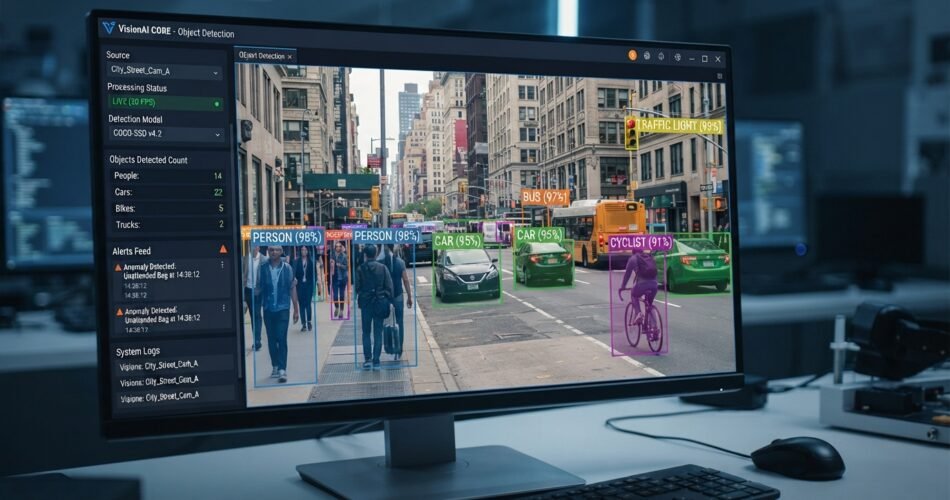
Businesses generate enormous amounts of visual information through security cameras, industrial monitoring systems, traffic networks, and digital inspection equipment. Every camera feed contains details about objects, movement, and activities, but collecting footage alone does not make that information useful. Organizations need technology that can interpret what cameras capture and identify details that matter to their operations. Computer vision is making this possible by turning ordinary visual data into structured information that can support faster decisions.
AI Object Detection Software plays a central role in this development. It enables machines to recognize objects, determine their positions, and analyze visual scenes through images and live video. Instead of relying entirely on people to watch screens or review recordings, businesses can use intelligent systems to identify selected objects and generate insights while activities are taking place.
The Changing Role of Camera Feeds in Modern Operations
For many years, cameras served mainly as recording and monitoring devices. They captured events that employees could review when an incident occurred or when visual evidence was required.
However, this approach has limitations. A business operating multiple facilities may have hundreds of cameras producing continuous footage. Monitoring every screen manually is difficult, and important details can easily go unnoticed.
Computer vision changes how organizations use this information. It allows software to examine camera feeds and recognize objects based on patterns learned through artificial intelligence.
A warehouse camera, for example, may capture packages, forklifts, and employees moving through different sections. An intelligent system can identify these objects and provide information about their locations. A traffic camera may recognize cars, buses, and pedestrians, helping operators understand activity on the road.
The camera still captures the images, but the software adds the ability to interpret them.
How AI Object Detection Software Turns Images Into Insights
Object detection involves several technical stages that transform raw images into recognizable objects and useful information.
Image Capture and Processing
The process begins when a camera captures an image or live video stream. The incoming video is divided into individual frames that can be analyzed by an AI model.
Before analysis, the software may resize images, adjust their dimensions, and prepare them for processing. These steps help ensure that visual information is presented in a format the model can understand.
Image quality is important at this stage. Poor lighting, low resolution, and unclear camera angles can make objects difficult to recognize.
Identifying Objects Within a Scene
Once a frame is prepared, the detection model examines its visual content and identifies objects that match its trained categories.
Depending on its purpose, the system may recognize people, vehicles, machinery, products, animals, or packages.
AI Object Detection Software can also estimate the location of each detected object. These positions are often displayed through bounding boxes that surround objects within an image.
The model may assign a confidence score to each prediction, helping the application determine whether the result meets a required threshold.
Tracking Movement Over Time
A single image provides information about one moment, but live video contains a continuous sequence of events.
When object detection is combined with tracking, the system can follow objects across multiple frames. It may monitor a vehicle moving through a parking facility or follow packages along a production line.
Tracking creates additional context by showing how objects change position over time. This information can help businesses understand movement patterns and identify activities that require attention.
Converting Detection Results Into Actions
The final stage involves connecting visual information with business processes.
A system may generate an alert when a vehicle enters a restricted area, notify employees when a shelf appears empty, or save a detection event for later review.
Detection results can also be sent to dashboards, reporting platforms, and other connected applications. This makes visual information easier to access and use in everyday operations.
Why Businesses Are Moving Beyond Traditional Video Monitoring
Traditional camera networks provide useful recordings, but they do not automatically explain what is happening. Intelligent video analysis helps organizations reduce the distance between capturing an event and understanding it.
Businesses can benefit from this approach in several ways.
- Faster identification: Systems can recognize selected objects while video is being processed.
- Reduced manual monitoring: Employees can focus on relevant events instead of continuously observing every camera.
- Improved operational visibility: Managers can gain information about activity across multiple facilities.
- Organized visual records: Detection events can be categorized and stored for easier investigation.
- Better workflow coordination: Alerts can be shared with the teams responsible for responding.
- More informed planning: Visual information can contribute to operational reports and performance analysis.
These benefits depend on accurate models, suitable camera conditions, and effective integration. Automated detection should support human decisions rather than be treated as a guaranteed interpretation of every situation.
Real World Applications of Computer Vision Across Industries
Computer vision is useful wherever organizations need to identify objects, monitor movement, or inspect visual information. Its applications continue to expand across different business environments.
Manufacturing and Production Monitoring
Manufacturing facilities contain production lines, components, tools, and machinery that need continuous attention.
AI-powered detection can identify products as they move through different stages and check whether expected components are present. For example, a camera may inspect an item before it moves to the next stage of production.
If the system detects a missing component or an object in an unexpected location, it can notify an operator for further inspection.
This approach can support quality control and reduce the time employees spend examining routine visual information. However, detection systems must be tested under actual factory conditions, including changing lighting and fast-moving machinery.
Transportation and Traffic Management
Road networks produce continuous video streams containing cars, buses, motorcycles, bicycles, and pedestrians.
Intelligent detection can recognize these categories and identify their positions within a camera feed. When combined with tracking, the system can provide additional information about vehicle movement and traffic density.
Transport authorities may use these insights to monitor congestion, study traffic patterns, and identify objects obstructing roadways.
The technology can support traffic management decisions, although it does not replace the need for proper infrastructure planning and human supervision.
Retail and Store Operations
Retail businesses can use computer vision to understand activity around shelves, checkout areas, and product displays.
Object detection may identify products, recognize empty shelf spaces, and support inventory monitoring. For example, a store could use intelligent cameras to identify shelves that need restocking.
When connected with inventory management software, these observations can help employees coordinate replenishment activities.
Retailers must also consider customer privacy and ensure that camera-based systems follow applicable data protection requirements.
Warehousing and Logistics
Warehouses depend on the movement of packages, pallets, forklifts, and delivery vehicles. As facilities grow, monitoring all these activities manually becomes increasingly difficult.
Computer vision can identify selected objects and track their movement through loading zones, sorting areas, and storage sections.
A warehouse may use detection to monitor forklift activity near pedestrian areas or identify packages moving through a sorting station. These insights can help supervisors investigate operational delays and improve coordination.
Healthcare and Medical Facilities
Hospitals manage equipment, supplies, employees, and visitors across different departments.
Intelligent camera systems may help identify selected equipment, monitor objects in designated locations, or support facility management activities.
For instance, a hospital could use computer vision to check whether essential equipment is present in a monitored storage area.
Healthcare applications require strict privacy and security measures. Visual detection should support approved operational processes rather than replace clinical judgment or professional monitoring.
Security and Building Management
Security teams often manage multiple camera feeds across offices, commercial properties, industrial facilities, and public infrastructure.
AI Object Detection Software can identify people, vehicles, and selected objects within monitored areas. It may generate alerts when an object enters a restricted zone or when predefined conditions are detected.
This helps security personnel prioritize important events and review relevant footage more efficiently.
However, detection systems can make mistakes because of poor lighting, unusual object appearances, or obstructed camera views. Human verification remains essential when decisions could affect personal safety or access rights.
The Technologies That Make Intelligent Video Analysis Possible
Object detection works as part of a wider computer vision environment. Several technologies contribute to its ability to analyze visual information and deliver useful results.
Artificial Intelligence and Deep Learning
Modern detection systems commonly use deep learning models trained on labeled images. These models learn visual patterns and use them to recognize objects in new images.
Different models offer different levels of speed and accuracy. The most suitable option depends on the objects being detected, the complexity of the environment, and the available computing resources.
Computer Vision and Image Processing
Computer vision provides the methods used to interpret images and video. Image processing prepares visual information so that AI models can analyze it more effectively.
Together, these technologies help systems recognize object shapes, positions, and other visual characteristics.
Edge Computing and Cloud Infrastructure
Some organizations process video close to the camera using edge devices. This can reduce communication delays and limit the amount of footage transferred across a network.
Other systems use centralized servers or cloud infrastructure to process information from multiple locations.
A hybrid approach may combine local detection with centralized reporting. The appropriate architecture depends on response time, network capacity, data sensitivity, and operating costs.
Integration With Business Applications
Visual detection becomes more useful when it connects with software already used by an organization.
For example, manufacturing platforms can receive inspection results, inventory systems can use product-related detections, and security dashboards can display alerts from connected cameras.
This integration allows visual information to become part of wider business workflows instead of remaining isolated within a camera system.
Challenges That Affect the Quality of Visual Insights
Although computer vision has advanced significantly, organizations must consider several limitations before implementation.
Detection accuracy is one of the most important concerns. Shadows, reflections, motion blur, low-resolution footage, and partially hidden objects can affect recognition results. Systems may produce false positives or fail to detect objects that are difficult to see.
Processing capacity also matters. Analyzing high-resolution footage from multiple cameras can require substantial computing resources. Businesses need to evaluate hardware, network performance, and processing requirements before selecting an architecture.
Training data influences how well a model performs in different environments. A model trained using limited examples may struggle when it encounters unfamiliar lighting conditions, object variations, or camera angles.
Privacy and security require equal attention. Organizations should define who can access recordings, how long footage is stored, and what information is necessary for each application.
Regular testing and maintenance help ensure that detection performance remains suitable as operating conditions change.
The Future of Camera Based Intelligence
Computer vision is moving toward more advanced forms of visual understanding. Future systems are expected to combine object detection with tracking, activity recognition, and information from multiple sensors.
This development may help organizations understand more complex events rather than simply identify individual objects.
For example, an industrial system could combine camera analysis with equipment sensor data to monitor production conditions. A logistics platform could connect object detections with warehouse management software to improve the visibility of package movement.
Edge AI is also expected to make intelligent video analysis more accessible by supporting faster local processing. As hardware and detection models improve, organizations may be able to analyze more video streams with greater efficiency.
However, successful adoption will continue to depend on reliable technology, responsible data handling, and appropriate human oversight.
Final Thought
Camera feeds contain valuable information, but their real potential becomes clear when machines can interpret what they capture. Computer vision is making this possible by identifying objects, analyzing movement, and turning visual data into structured insights.
AI Object Detection Software provides the foundation for this transformation. It helps businesses move beyond passive recording and use camera information to support manufacturing, transportation, retail, logistics, healthcare, and security operations.
As intelligent vision systems continue to develop, the value of cameras will increasingly depend on what organizations can learn from their footage. The combination of accurate detection, useful software integration, and responsible implementation will shape the next generation of visual business intelligence.