When people compare insurance policies, the premium is usually the first number they look at. A policy that costs $1,200 a year can immediately seem better than one that costs $1,500. But there is another number that can completely change the value of the policy: the deductible.
A deductible is the amount you agree to pay toward a covered claim before the insurance company pays its share. The tricky part is that choosing a lower deductible usually means paying a higher premium, while choosing a higher deductible can reduce the premium but leave you responsible for more money when something goes wrong. A deductible comparison calculator PlainPayment deductible comparison calculator can make that trade-off easier to see by comparing the premium savings with the additional amount you would have to pay after a claim.
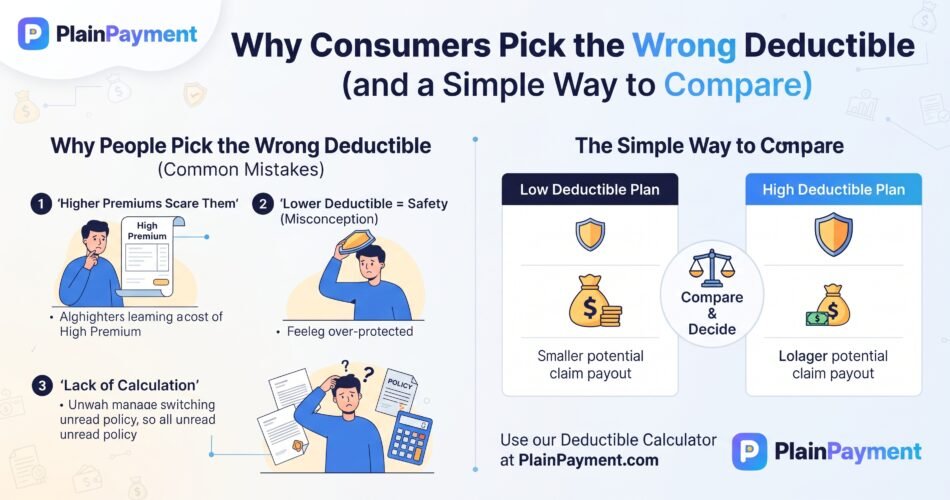
The problem is that consumers often choose deductibles based on one of two instincts: “I want the lowest possible out-of-pocket cost” or “I want the cheapest insurance premium.” Neither approach tells the whole story.
The better question is:
How much am I saving in premiums, and is that savings worth taking on the additional financial risk?
What Is an Insurance Deductible?
A deductible is the amount you generally pay toward a covered loss before your insurance coverage responds, subject to the specific terms of your policy.
For example, suppose your auto insurance policy has a $500 deductible and you have a covered repair costing $3,000.
If the loss is fully covered and no other policy provisions change the calculation, you could be responsible for the first $500 while the insurer covers the remaining eligible amount.
Now imagine the same policy with a $1,500 deductible.
You could potentially save money on your premium by accepting the higher deductible, but you would have to absorb an additional $1,000 if you had a qualifying claim.
That is the basic trade-off.
| Lower deductible | Higher deductible |
|---|---|
| Usually higher premium | Usually lower premium |
| Less to pay when a covered claim occurs | More to pay when a covered claim occurs |
| Lower financial risk at claim time | Higher financial risk at claim time |
| May make sense for people with limited savings | May make sense for people with sufficient emergency savings |
The right choice depends on the policy, your finances, your risk tolerance, and how much the premium actually changes.
Why People Often Choose the Wrong Deductible
The most common mistake is treating the deductible as an isolated number.
Someone might say:
“I want a $500 deductible because I don’t want to pay $1,500 after an accident.”
That sounds reasonable.
But what if increasing the deductible from $500 to $1,500 reduces the annual premium by $400?
Now the decision is different.
You are effectively deciding whether you want to pay an additional $1,000 after a claim in exchange for saving $400 every year.
If you went five years without a claim, you would save approximately $2,000 in premiums.
If you had a qualifying claim during the first year, however, you would face the larger deductible immediately.
The important thing is not simply whether the deductible is “high” or “low.”
It is whether the premium savings justify the additional financial exposure.
The Premium Can Distract You From the Real Cost
Insurance shopping encourages people to focus heavily on the premium because it is easy to compare.
Policy A:
- $1,500 annual premium
- $500 deductible
Policy B:
- $1,200 annual premium
- $1,500 deductible
At first glance, Policy B looks better because it saves $300 a year.
But the two policies are not financially identical.
The buyer is accepting another $1,000 of potential out-of-pocket cost in exchange for the $300 annual premium reduction.
That creates a simple comparison:
| Item | Policy A | Policy B |
|---|---|---|
| Annual premium | $1,500 | $1,200 |
| Deductible | $500 | $1,500 |
| Annual premium savings | — | $300 |
| Additional deductible exposure | — | $1,000 |
This does not automatically make Policy A better.
It simply shows what you are giving up to get the lower premium.
The Simple Break-Even Method
One of the easiest ways to compare deductibles is to calculate the break-even point.
The basic idea is:
Additional deductible ÷ annual premium savings = break-even years
Suppose:
- Current deductible = $500
- New deductible = $1,500
- Additional deductible = $1,000
- Current premium = $1,500
- New premium = $1,250
- Annual premium savings = $250
The calculation is:
$1,000 ÷ $250 = 4 years
That means you would need approximately four claim-free years for the premium savings to equal the additional deductible exposure from one claim.
This is not a prediction of what will happen.
It is simply a way to understand the trade-off.
If you go four years without a qualifying claim, the premium savings add up to approximately $1,000.
If you have a qualifying claim immediately, you may have to pay the additional $1,000 much sooner.
That is why a deductible decision is partly a risk-management decision.
A Better Way to Compare Two Deductibles
Instead of looking at the premium alone, write down four numbers:
- Current annual premium
- New annual premium
- Current deductible
- New deductible
Then calculate:
Annual premium savings = current premium − new premium
And:
Additional deductible = new deductible − current deductible
Then divide the additional deductible by the annual premium savings.
Here is an example:
| Comparison | Amount |
|---|---|
| Lower deductible | $500 |
| Higher deductible | $2,000 |
| Lower-deductible premium | $1,800/year |
| Higher-deductible premium | $1,400/year |
| Annual savings | $400 |
| Additional deductible | $1,500 |
| Break-even | 3.75 years |
The higher deductible saves $400 every year.
But it also creates another $1,500 of potential out-of-pocket exposure after a covered claim.
The break-even point is approximately 3.75 years.
That gives you much more useful information than simply knowing that one policy is $400 cheaper.
Your Emergency Fund May Matter More Than the Premium
This is where the decision becomes personal.
Imagine two people receive exactly the same insurance quotes.
Person A has $30,000 in easily accessible emergency savings.
Person B has $1,500 in savings and very little room in their monthly budget.
A $2,000 deductible creates a very different risk for these two people.
For Person A, paying a $2,000 deductible may be uncomfortable but manageable.
For Person B, the same deductible could create a serious financial problem.
That means the cheapest annual premium is not necessarily the best choice.
Before choosing a higher deductible, ask:
- Could I pay the deductible tomorrow?
- Would paying it require using a credit card?
- Would I have to borrow money?
- Would paying it eliminate my emergency fund?
- Could I still pay rent or a mortgage afterward?
- Would the expense interfere with other essential bills?
If the answer to these questions is no, the premium savings may not justify the risk.
Don’t Choose a Deductible You Cannot Afford
This is probably the simplest rule to remember.
A deductible is only a good option if you can realistically pay it when you need to.
It is easy to choose a $2,500 deductible while everything is going well.
It is much harder to come up with $2,500 immediately after a major accident, storm, theft, or other covered event.
The whole purpose of insurance is to transfer financial risk.
Choosing a very high deductible transfers more of the initial loss back to you.
That may be perfectly reasonable if you have enough cash to handle it.
But it can be a poor choice if the deductible would force you into debt.
Compare Identical Coverage
Another major mistake is comparing policies that are not actually equivalent.
Suppose:
Policy A
- $1,400 premium
- $500 deductible
- Higher liability limits
- More optional coverage
Policy B
- $1,000 premium
- $1,500 deductible
- Lower liability limits
- Fewer optional coverages
You cannot fairly conclude that Policy B is cheaper simply because its premium is lower.
You may be comparing two different products.
When comparing deductibles, try to keep these factors consistent:
- Liability limits
- Collision coverage
- Comprehensive coverage
- Property coverage
- Personal property limits
- Optional endorsements
- Coverage limits
- Exclusions
- Deductibles
Only then does the premium-versus-deductible comparison become meaningful.
Auto Insurance Deductibles
Auto insurance is one of the most common places consumers encounter deductible choices.
Collision and comprehensive coverage can have deductibles, while liability coverage generally works differently.
For example, you might see options such as:
- $250 deductible
- $500 deductible
- $1,000 deductible
- $1,500 deductible
- $2,000 deductible
A driver with an older vehicle may evaluate the decision differently from someone with a newer, expensive vehicle.
Your driving history and where you live can also affect how you think about the risk.
Before comparing premiums, make sure you are comparing the same coverage.
A car insurance estimator PlainPayment car insurance estimator can help put different insurance quotes on a comparable annual basis when the quotes are presented in different billing formats.
That matters because one insurer may quote a monthly amount while another quotes a six-month or annual premium.
Homeowners Insurance Deductibles
Home insurance can make deductible decisions even more important because a major covered loss can be expensive.
You may encounter deductibles such as:
- $500
- $1,000
- $2,500
- $5,000
- A percentage-based deductible for certain types of losses
A homeowner should not automatically choose the lowest deductible.
But they also should not automatically choose the highest one simply to reduce the premium.
Think about the financial exposure.
If your deductible is $5,000, could you comfortably produce that money after a major covered loss?
A home insurance calculator PlainPayment home insurance calculator can also help you think about the broader insurance cost, including dwelling coverage, quoted premium, and deductible.
The deductible is only one part of the policy.
Coverage limits and exclusions matter too.
Renters Insurance Has a Similar Trade-Off
Renters may have fewer property-related costs than homeowners, but deductible decisions still matter.
Suppose you have valuable electronics, furniture, clothing, and other belongings.
If a covered event damages or destroys your property, the deductible can affect how much of the initial loss you absorb.
Before selecting coverage, first estimate what your belongings would cost to replace.
A renters insurance calculator PlainPayment renters insurance calculator can help you think through the amount of personal property coverage you may need based on the replacement value of your belongings.
Then you can consider whether the deductible fits your financial situation.
Not Every Deductible Works the Same Way
Another reason people get confused is that deductibles can operate differently depending on the insurance product and policy.
For example, a policy may have:
- A flat-dollar deductible
- A percentage deductible
- Different deductibles for different types of losses
- Separate deductibles for different coverage sections
A homeowner might have one deductible for many covered losses but a different percentage-based deductible for certain weather-related events.
That means you should read the policy rather than assuming that one deductible applies to everything.
The number printed next to “deductible” is not always enough information.
What Happens If the Claim Is Smaller Than the Deductible?
This is another simple but important point.
Suppose your deductible is $1,000 and you have $700 in covered damage.
If the applicable deductible is $1,000, the loss may not result in an insurance payment because the covered loss is below the deductible.
That means your deductible can affect not only how much you pay after a large claim, but also whether a smaller claim is worth filing.
For this reason, some people with higher deductibles may decide to handle smaller losses themselves.
But the decision to file a claim can depend on the policy and circumstances, so do not assume that every small loss should simply be ignored.
Don’t Forget That Premiums Can Change
A deductible comparison is not a guarantee that your premium will remain unchanged forever.
Insurance premiums can change at renewal because of:
- Claims history
- Changes in underwriting
- Inflation
- Repair costs
- Local loss trends
- Changes in your property
- Changes in your vehicle
- Changes in insurer pricing
Therefore, a deductible that makes sense today may be worth reviewing later.
For example, if your emergency savings increase substantially over several years, you may be more comfortable taking on a higher deductible.
On the other hand, if your financial situation becomes tighter, a lower deductible may become more attractive.
A Simple Example: $500 vs. $1,500 Deductible
Let’s put everything together.
Suppose you receive two otherwise identical quotes.
Option A
- Annual premium: $1,800
- Deductible: $500
Option B
- Annual premium: $1,500
- Deductible: $1,500
Option B saves:
$300 per year
But the deductible is:
$1,000 higher
The basic break-even calculation is:
$1,000 ÷ $300 = 3.33 years
So it would take about 3.33 claim-free years for the premium savings to equal the additional deductible exposure from one claim.
Now consider three hypothetical outcomes.
| Situation | Lower deductible | Higher deductible |
|---|---|---|
| No claim for 1 year | Pays $1,800 | Pays $1,500 |
| No claim for 5 years | Pays $9,000 | Pays $7,500 |
| One qualifying $5,000 claim in year 1 | Higher premium + $500 deductible | Lower premium + $1,500 deductible |
Over five claim-free years, the higher deductible saves $1,500 in premiums.
But if a claim occurs early, you may have to absorb the larger deductible.
There is no universally correct answer.
The decision depends on how you value predictable premiums versus lower claim-time exposure.
Expected Cost Can Help, But It Is Not the Whole Answer
You can also think about expected cost.
Suppose:
- Lower-deductible premium = $1,800
- Higher-deductible premium = $1,500
- Lower deductible = $500
- Higher deductible = $1,500
If you estimate a 10% annual chance of a qualifying claim, a simplified comparison might look like this:
| Lower deductible | Higher deductible | |
|---|---|---|
| Annual premium | $1,800 | $1,500 |
| Estimated claim probability | 10% | 10% |
| Deductible | $500 | $1,500 |
| Simplified expected deductible cost | $50 | $150 |
| Simplified expected annual cost | $1,850 | $1,650 |
The higher deductible looks cheaper under this simplified assumption.
But this calculation has limitations.
It does not predict whether you will actually have a claim.
It may not account for different types of claims, claim frequency, coverage limits, claim-related premium changes, or other policy conditions.
So expected cost should be treated as a planning tool—not a guarantee.
The “Cheapest” Deductible Is the One That Fits Your Risk
There is no magic deductible number that works for everyone.
A $500 deductible may be appropriate for one household.
A $1,500 deductible may be better for another.
Someone else may prefer $2,500 because they have substantial emergency savings and want to minimize their recurring premium.
The important question is:
What level of financial risk can I comfortably carry?
Then compare how much the insurer charges you for transferring more or less of that risk.
Five Questions to Ask Before Choosing
Before selecting your deductible, ask yourself:
1. How much do I save by increasing the deductible?
If moving from $500 to $1,500 only saves $50 per year, the additional risk may not be worth it.
If it saves $500 per year, the calculation is different.
2. Can I pay the higher deductible immediately?
If not, the higher deductible may create more financial stress than the premium savings are worth.
3. How likely am I to have a claim?
Your past experience and circumstances can help you think about risk, but no personal estimate can perfectly predict future claims.
4. Am I comparing identical coverage?
A lower premium is not necessarily better if it comes with lower coverage limits or important exclusions.
5. Will my financial situation change?
Your deductible decision should be revisited as your emergency fund, income, vehicle, home, or other circumstances change.
A Practical Deductible Comparison Checklist
Use this checklist when reviewing insurance quotes:
Write down the annual premium.
Write down the deductible.
Calculate the premium savings.
Calculate the additional deductible exposure.
Calculate the break-even period.
Confirm the coverage limits are identical.
Check whether different deductibles apply to different risks.
Check whether the deductible is a flat amount or percentage.
Make sure you could afford the deductible.
Consider your emergency savings.
Think about your likelihood of making a claim.
Review exclusions.
Check whether the policy has special conditions.
Revisit the decision at renewal.
The Bottom Line
Consumers often choose the wrong deductible because they focus on the wrong number.
Some people choose the lowest deductible because they want to minimize their out-of-pocket cost after a claim.
Others choose the highest deductible because they want the lowest possible premium.
Neither approach is automatically correct.
The better strategy is to compare the annual premium savings against the additional deductible exposure.
Start with the simple calculation:
Additional deductible ÷ annual premium savings = approximate break-even period
Then ask the question that matters most:
Could I comfortably pay the higher deductible if I needed to?
If the answer is yes, a higher deductible may be worth considering.
If the answer is no, saving a little on the annual premium may not justify taking on a financial obligation you cannot comfortably handle.
And remember that deductible is only one part of an insurance policy. Coverage limits, exclusions, policy conditions, premium, claims handling, and your own financial situation all matter.
The goal is not to find the lowest premium or the lowest deductible.
The goal is to choose the combination of premium and deductible that gives you the level of protection you can afford and the amount of financial risk you are comfortable keeping yourself.
FAQs
What is an insurance deductible?
An insurance deductible is the amount you are generally responsible for paying toward a covered loss before the insurance policy pays the remaining eligible amount, subject to the terms and conditions of the policy.
Is a higher deductible always cheaper?
A higher deductible often comes with a lower premium, but it is not necessarily cheaper overall. You need to compare the premium savings with the additional amount you would have to pay if a covered claim occurs.
How do I know if my deductible is too high?
A deductible may be too high if paying it would require you to use money needed for essential expenses, borrow money, carry a credit-card balance, or significantly reduce your emergency savings.
What is the easiest way to compare two deductibles?
Compare the annual premium difference and the deductible difference. Divide the additional deductible by the annual premium savings to estimate how many claim-free years it would take for the premium savings to equal the additional deductible.
Should I choose a $500 or $1,000 deductible?
There is no universal answer. Compare how much the higher deductible reduces your premium and determine whether you could comfortably pay the additional amount after a covered claim.
Does a higher deductible lower my insurance premium?
Often it can, because you are agreeing to take on more of the initial financial risk. The exact premium reduction depends on the insurer, policy, coverage type, location, and other factors.
What happens if my claim is smaller than my deductible?
If the covered loss is below the applicable deductible, the insurance policy may not pay anything toward that loss. The exact treatment depends on the policy and type of coverage.
Can I change my deductible later?
In many cases, you can request a different deductible when changing or renewing a policy. However, availability and the effect on your premium depend on the insurer and policy.
Should I choose a higher deductible if I have a large emergency fund?
A large emergency fund may make a higher deductible easier to manage, but it does not automatically make it the best choice. Compare the actual premium savings with the additional risk.
Does the deductible apply to every type of insurance claim?
Not necessarily. Policies can have different deductibles for different coverage types or specific causes of loss. Always review the policy language to understand which deductible applies.
Is a lower deductible always better for families?
Not necessarily. A lower deductible can reduce the amount paid after a covered claim, but it may come with a higher premium. Families should consider both their monthly budget and their ability to handle an unexpected expense.
Should I choose insurance based only on the deductible?
No. Deductible is only one factor. You should also compare coverage limits, exclusions, premium, policy conditions, financial protection, and the insurer’s terms.
How often should I review my deductible?
Review it whenever your financial circumstances change and at policy renewal. Changes in savings, income, vehicle value, home ownership, or other circumstances can affect how much deductible you are comfortable carrying.