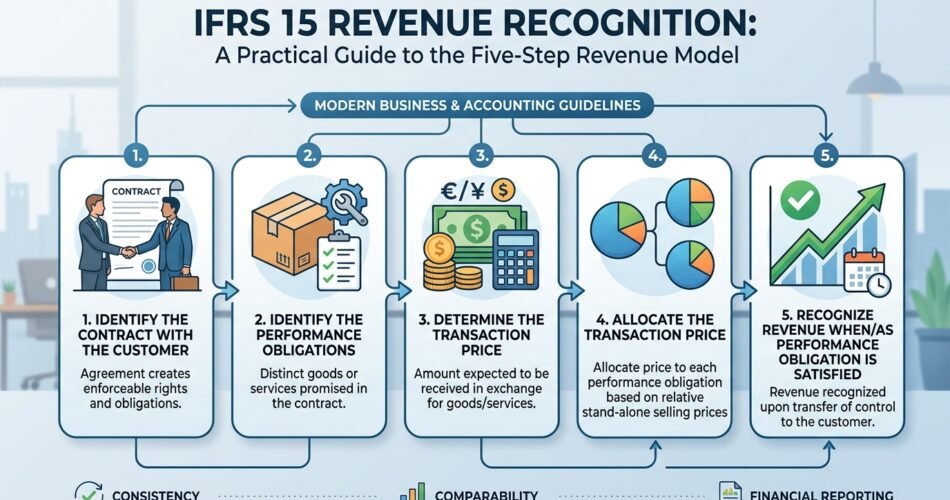
IFRS 15 accounting standards provide a comprehensive framework for recognizing revenue from contracts with customers. The standard helps businesses determine when revenue should be recorded, how much should be recognized, and how financial information should be presented in their financial statements.
For organizations operating in Kuwait and internationally, understanding IFRS 15 is important for maintaining consistent accounting practices, preparing reliable financial reports, and communicating financial performance to stakeholders. The standard applies across many industries, including construction, technology, telecommunications, retail, manufacturing, and professional services.
IFRS 15 replaced several earlier revenue recognition requirements with a unified model based on the transfer of promised goods or services to customers. Instead of relying only on invoices or cash receipts, companies need to evaluate the terms of their customer contracts and determine when their performance obligations are satisfied.
This article explains the purpose of IFRS 15, its five-step revenue recognition model, practical accounting considerations, common challenges, and ways businesses can improve compliance.
1. What Is IFRS 15?
IFRS 15, Revenue from Contracts with Customers, is an International Financial Reporting Standard issued by the International Accounting Standards Board (IASB). It establishes principles for reporting useful information about the nature, amount, timing, and uncertainty of revenue and cash flows arising from customer contracts.
The standard is built around a core principle: a business recognizes revenue to depict the transfer of promised goods or services to customers in an amount that reflects the consideration it expects to receive in exchange.
In simple terms, a company should recognize revenue when it fulfills its contractual promises, rather than automatically recording revenue when it receives cash or issues an invoice.
Why was IFRS 15 introduced?
Before IFRS 15, revenue recognition requirements were spread across different standards and interpretations. The introduction of a common framework was intended to improve consistency and comparability across industries and transactions.
The standard provides a structured method for evaluating contracts, identifying separate promises, determining the transaction price, and recognizing revenue as those promises are fulfilled.
Who uses IFRS 15?
IFRS 15 is relevant to entities that prepare financial statements under IFRS and enter into contracts with customers, subject to the standard’s scope and exceptions.
It can affect:
- Construction and engineering companies.
- Software and technology businesses.
- Retailers and manufacturers.
- Telecommunications providers.
- Professional service firms.
- Real estate and project-based businesses.
- Companies offering subscriptions or bundled services.
The accounting outcome depends on the contract terms and the facts of each arrangement.
2. The Five-Step Model of IFRS 15
The central feature of IFRS 15 is its five-step revenue recognition model. Businesses use these steps to analyze customer contracts and determine the appropriate timing and amount of revenue.
IFRS 15 revenue recognition framework
- Identify the contract with the customer
Determine whether an enforceable agreement meets the standard’s contract criteria. - Identify performance obligations
Identify distinct goods or services promised to the customer. - Determine the transaction price
Estimate the consideration the business expects to receive. - Allocate the transaction price
Assign the transaction price to the separate performance obligations. - Recognize revenue
Recognize revenue when or as each performance obligation is satisfied.
Each step is connected to the others. If a contract includes multiple goods or services, for example, a company may need to identify separate obligations and allocate the total contract price between them before recording revenue.
3. Step One: Identify the Contract with the Customer
The first step is to determine whether an agreement with a customer qualifies as a contract under IFRS 15.
A contract may be written, oral, or implied by customary business practices, depending on the circumstances and applicable law. The important consideration is whether the agreement creates enforceable rights and obligations and meets the standard’s recognition criteria.
Generally, the parties must have approved the arrangement and be committed to performing their obligations. The business should be able to identify each party’s rights, payment terms, and the commercial substance of the arrangement. It must also be probable that the entity will collect the consideration to which it expects to be entitled.
Example
A consulting company signs an agreement with a customer to provide a six-month advisory service. The contract specifies the services, payment schedule, and responsibilities of both parties.
The company evaluates the agreement against IFRS 15’s contract criteria before determining how to recognize the revenue.
If the arrangement does not meet the criteria, amounts received may need to be treated differently until the applicable requirements are met.
4. Step Two: Identify Performance Obligations
A performance obligation is a promise in a customer contract to transfer a distinct good or service, or a series of distinct goods or services that are substantially the same and have the same pattern of transfer.
This step is important because revenue recognition is based on the satisfaction of performance obligations, not simply on the existence of a contract.
What makes a good or service distinct?
A promised good or service is generally distinct when:
- The customer can benefit from it on its own or together with other readily available resources.
- The promise to transfer it is separately identifiable from other promises in the contract.
A company must consider both conditions when identifying distinct performance obligations.
Example: Software and implementation services
A technology company sells a software subscription together with implementation assistance.
If the customer can benefit from the software separately and the implementation service is distinct from the subscription, the company may need to account for them as separate performance obligations.
If the implementation significantly integrates, modifies, or customizes the software in a way that makes the promises inseparable, the accounting assessment may be different.
The conclusion depends on the specific contract and the nature of the promised services.
5. Step Three: Determine the Transaction Price
The transaction price is the amount of consideration an entity expects to be entitled to receive in exchange for transferring promised goods or services to a customer, excluding amounts collected on behalf of third parties, such as certain sales taxes.
The transaction price may be fixed, variable, or a combination of both.
Fixed consideration
Fixed consideration is an amount specified in the contract, such as a set fee for delivering a service.
Variable consideration
Variable consideration may arise from:
- Discounts and rebates.
- Performance bonuses.
- Refunds.
- Service-level penalties.
- Incentive payments.
- Price concessions.
When consideration is variable, the entity estimates the amount using an appropriate method, such as the expected value or most likely amount method, depending on which better predicts the consideration.
The estimate is subject to a constraint: revenue should include variable consideration only to the extent that it is highly probable that a significant reversal will not occur when the uncertainty is resolved.
Example
A contractor agrees to complete a project for a fixed fee, with an additional bonus if the project meets an agreed completion target.
The contractor must assess whether the bonus is variable consideration, estimate the amount where appropriate, and consider the constraint before including it in the transaction price.
6. Step Four: Allocate the Transaction Price
When a contract contains more than one performance obligation, the transaction price is generally allocated to each obligation based on its relative stand-alone selling price.
A stand-alone selling price is the price at which an entity would sell a promised good or service separately to a customer.
If a stand-alone selling price is not directly observable, the business estimates it using an appropriate method.
Example: A bundled business package
A company sells a customer a package containing:
- A software subscription.
- Initial setup services.
- Ongoing technical support.
If these items are distinct performance obligations, the company generally allocates the total transaction price between them using their relative stand-alone selling prices.
This means that the company should not automatically recognize the entire package price when the first service is delivered. It needs to determine how much consideration relates to each obligation and recognize revenue according to the satisfaction of each one.
7. Step Five: Recognize Revenue When Obligations Are Satisfied
The final step is to recognize revenue when or as the entity satisfies a performance obligation by transferring control of a promised good or service to the customer.
IFRS 15 distinguishes between obligations satisfied over time and those satisfied at a point in time.
Revenue recognized over time
Revenue is recognized over time when one of the standard’s criteria is met. Broadly, this can include circumstances where:
- The customer simultaneously receives and consumes the benefits as the entity performs.
- The entity’s performance creates or enhances an asset that the customer controls as it is created or enhanced.
- The entity’s performance does not create an asset with an alternative use to the entity, and the entity has an enforceable right to payment for performance completed to date.
When an obligation is satisfied over time, the business selects a suitable measure of progress that faithfully depicts the transfer of goods or services.
Revenue recognized at a point in time
If the performance obligation does not qualify for over-time recognition, revenue is recognized at the point in time when control transfers to the customer.
Indicators may include the customer obtaining legal title, physical possession, significant risks and rewards of ownership, or acceptance of the asset, depending on the arrangement.
The company should assess the full facts rather than rely on a single indicator.
8. Practical IFRS 15 Accounting Example
Consider a consulting company in Kuwait that signs a contract for 10,000 KWD to provide a three-month business advisory service.
Assume the service is a single performance obligation satisfied over time, and the company determines that progress can be measured using the proportion of services delivered.
If the company has completed 40% of the service by the reporting date, and that measure faithfully represents its progress, it may recognize 4,000 KWD of revenue, subject to the contract terms and applicable requirements.
The simplified calculation is:
10,000×40%=4,000 KWD10,000 times 40% = 4,000text{ KWD}10,000×40%=4,000 KWD
The remaining 6,000 KWD would be recognized as the company completes the remaining service, assuming the transaction price and progress estimate do not change.
This example illustrates why revenue recognition may differ from the timing of customer payments. If the customer paid the full contract amount in advance, the company would not necessarily recognize the entire payment as revenue immediately. It would consider the performance obligation and recognize revenue as the service is transferred.
9. Contract Assets, Contract Liabilities, and Receivables
IFRS 15 also affects how businesses present amounts related to customer contracts in their financial statements.
Understanding the difference between contract assets, contract liabilities, and receivables is important for accurate reporting.
Contract asset
A contract asset arises when an entity has transferred goods or services to a customer but its right to consideration is conditional on something other than the passage of time.
For example, a company may have completed part of a project and recognized revenue, but its right to invoice may depend on completing an additional contractual milestone.
Contract liability
A contract liability arises when a customer pays consideration, or the amount becomes due, before the entity transfers the related goods or services.
For example, a customer may pay for a six-month subscription in advance. The business generally recognizes the amount as revenue as it provides the subscription service, while the unearned portion is presented as a contract liability.
Receivable
A receivable represents an unconditional right to consideration. The only remaining requirement before payment is due is the passage of time.
These balances should be classified based on the substance of the contractual rights and obligations rather than simply on whether an invoice has been issued.
Conclusion
IFRS 15 Accounting Standards provide a structured framework for recognizing revenue and presenting it accurately in financial statements. By following the five-step revenue recognition model, businesses can identify customer contracts, determine transaction prices, allocate revenue to performance obligations, and recognize income when goods or services are transferred to customers.
Understanding IFRS 15 helps organizations maintain consistent financial reporting, improve transparency, and manage complex customer agreements more effectively. Although implementation may involve challenges such as contract assessments, variable consideration, and documentation, clear procedures and appropriate accounting systems can support compliance.
For businesses in Kuwait and beyond, staying informed about IFRS 15 requirements is an important part of maintaining reliable financial records and meeting reporting responsibilities. Regular reviews, staff training, and professional accounting guidance can help organizations apply the standard correctly and strengthen their overall financial reporting practices.