BMI Calculator: Calculate Your Body Mass Index
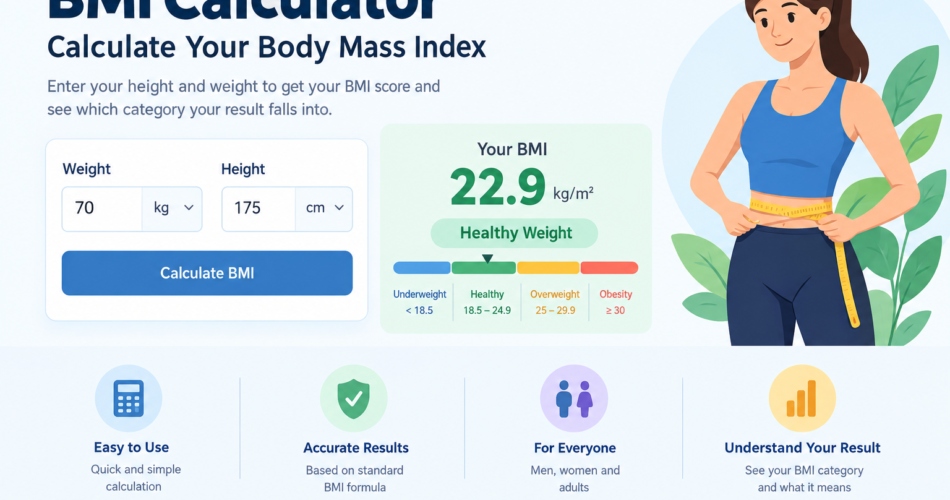
Use this BMI calculator to calculate your Body Mass Index from your height and weight. Enter your measurements to get your BMI score and see which standard weight category your result falls into. You can use metric measurements such as kilograms and centimeters or the equivalent imperial measurements.
BMI, or Body Mass Index, is a simple screening measurement based on body weight and height. It can help indicate whether an adult’s weight falls within a commonly used range for their height, but it does not directly measure body fat or provide a complete picture of health.
What Is BMI?
BMI stands for Body Mass Index. It is a numerical measurement calculated from a person’s weight and height.
For adults, BMI is commonly used as a screening tool to place body weight into categories such as underweight, healthy weight, overweight, or obesity. The calculation is the same for adult men and women, although BMI should be interpreted in context because people with the same BMI can have different amounts and distributions of muscle and body fat.
A BMI result is therefore best viewed as one piece of information rather than a diagnosis.
How to Calculate BMI
The BMI formula uses your body weight and height.
For metric measurements:
BMI = weight in kilograms ÷ height in meters²
For example, if someone weighs 70 kg and is 1.75 meters tall:
BMI = 70 ÷ (1.75 × 1.75)
BMI = 22.9 kg/m²
For imperial measurements using pounds and inches:
BMI = 703 × weight in pounds ÷ height in inches²
The two equations produce the same BMI value when the measurements are converted correctly.
If you are wondering how to calculate BMI, the key is to use your weight and height in the appropriate units before applying the equation.
BMI Calculator for Adults
For adults, BMI is generally interpreted using established ranges. A commonly used adult classification places BMI below 18.5 in the underweight range, 18.5 to below 25 in the healthy-weight range, 25 to below 30 in the overweight range, and 30 or higher in the obesity range.
| BMI | Weight category |
|---|---|
| Below 18.5 | Underweight |
| 18.5 to below 25 | Healthy weight |
| 25 to below 30 | Overweight |
| 30 or higher | Obesity |
These categories are useful for screening, but they should not be interpreted as an exact measurement of an individual’s health.
Your BMI may be affected by factors that the basic calculation does not include, such as muscle mass, body composition, age, and other individual characteristics.
BMI Calculator for Women and Men
There is no separate BMI formula for women and men. The standard adult BMI equation uses the same height and weight calculation for both.
However, sex can be relevant when interpreting BMI because people of the same BMI may have different body-fat levels and body compositions. Women, for example, generally have a different body-fat distribution than men at the same BMI.
This means a BMI calculator for women and a BMI calculator for men can use the same basic calculation, while the result may need to be considered alongside other health and body-composition information.
BMI Calculator in kg/m²
BMI is commonly expressed in kg/m², which means kilograms per square meter.
If you use the metric system, enter:
- Weight in kilograms (kg)
- Height in meters (m)
The calculation produces a BMI value in kg/m².
If your height is given in centimeters, convert it to meters before using the formula.
For example:
175 cm = 1.75 m
A person weighing 70 kg and measuring 175 cm would therefore have a BMI of approximately 22.9 kg/m².
A calculator can perform these conversions automatically, which makes it easier to calculate BMI online without doing the equation manually.
BMI Scale and Weight Categories
A BMI scale helps put the calculated number into context.
For adults, commonly used categories are:
Underweight
A BMI below 18.5 is generally classified as underweight.
Being underweight can sometimes be associated with inadequate nutrition or an underlying health issue. However, BMI alone cannot determine why someone has a low body weight.
Healthy Weight
A BMI from 18.5 to below 25 is commonly classified as healthy weight for adults.
This range is a population-level screening reference and does not guarantee that a person is healthy.
Overweight
A BMI from 25 to below 30 is generally classified as overweight.
A higher BMI can be associated with increased health risks, but BMI does not distinguish between fat mass and muscle mass.
Obesity
A BMI of 30 or higher is generally classified as obesity in adult BMI classification systems.
Higher BMI levels can be associated with increased risk for several health conditions, but a BMI result should be considered together with other relevant health information.
Is BMI the Same for Children and Adults?
No. Adult BMI categories should not simply be applied to children.
For children and teenagers, BMI is interpreted differently because body composition changes with age and development. BMI-for-age percentiles are commonly used for children and adolescents rather than the fixed adult BMI ranges.
If you are checking BMI for a child or teenager, use an age-appropriate BMI-for-age method rather than interpreting the result with the adult table above.
A future guide on BMI for children can explain BMI-for-age percentiles, growth patterns, and how results are interpreted.
What Does My BMI Result Mean?
Your BMI result gives you a numerical estimate based on your height and weight.
For example, a result of:
22.9 kg/m²
falls within the commonly used healthy-weight range for adults.
However, the number does not tell you everything about your health. Two people can have the same BMI while having very different levels of muscle, body fat, fitness, or fat distribution.
For this reason, your BMI should be treated as a screening measurement rather than a complete assessment of your health.
Does BMI Measure Body Fat?
No. BMI does not directly measure body fat.
It is calculated from height and weight, so it cannot determine how much of a person’s weight comes from muscle, fat, bone, or other tissues.
This is particularly important for people with substantial muscle mass. An athlete or bodybuilder may have a relatively high BMI because muscle contributes to body weight, even when their body-fat level is not high.
BMI can also be less informative in some older adults because body composition changes with age.
If you need a more detailed assessment of body composition, measurements such as waist circumference or body-fat measurements may provide additional information. These should not automatically be treated as interchangeable with BMI.
BMI and Waist Measurement
BMI and waist measurement provide different types of information.
BMI relates body weight to height. A waist measurement provides information about abdominal size and can be useful when considering body-fat distribution.
A person can have a BMI within a standard range while carrying more fat around the abdomen, while another person may have a higher BMI because of greater muscle mass.
For that reason, BMI can be considered alongside other measurements rather than used as the only indicator of health.
BMI and Body Fat
A BMI calculator with body fat would involve information beyond the standard BMI equation because BMI itself only requires height and weight.
Body-fat percentage is a different measurement. It estimates the proportion of a person’s body weight that consists of fat.
BMI and body-fat percentage should therefore not be confused:
BMI: based on height and weight.
Body-fat percentage: estimates body composition.
A person’s BMI may be useful for general screening, while body-composition measurements can provide additional information when appropriate.
Can BMI Tell Me My Ideal Weight?
BMI can be used to estimate the weight range associated with a particular BMI range for a given height.
However, there is no single body weight that is automatically ideal for every person of the same height.
For example, two people with the same height may have different amounts of muscle and body fat and may have different healthy weight targets.
Rather than treating an ideal body weight as one exact number, it is more useful to consider a reasonable range and the person’s broader health circumstances.
BMI Limitations
BMI is useful because it is simple, inexpensive, and easy to calculate. However, it has important limitations.
The standard calculation does not directly account for:
- Muscle mass
- Body-fat percentage
- Bone mass
- Fat distribution
- Physical activity
- Individual medical conditions
- Differences in body composition
For example, a muscular athlete may have a higher BMI because of muscle mass. Conversely, someone with a relatively normal BMI may still have a higher body-fat percentage.
BMI should therefore be considered alongside other relevant information when assessing an individual’s health.
How Accurate Is a BMI Calculator?
A BMI calculator is mathematically accurate when the correct height and weight are entered and the appropriate equation is used.
The more important limitation is what the resulting BMI can tell you.
The calculation accurately produces a BMI value, but that value is only a screening indicator. It does not provide a direct measurement of body fat or overall health.
Accuracy therefore has two parts:
Calculation accuracy: whether the BMI equation was applied correctly.
Interpretation: whether BMI is an appropriate measure for the particular person.
Keeping this distinction in mind can help prevent overinterpreting a single BMI number.
Metric and Imperial BMI Calculation
You can calculate BMI using either metric or imperial measurements.
Metric BMI
Use:
Weight: kilograms
Height: meters
Formula:
BMI = kg ÷ m²
Imperial BMI
Use:
Weight: pounds
Height: inches
Formula:
BMI = 703 × lb ÷ in²
If you use an online calculator, you do not need to manually convert every measurement. The calculator can perform the calculation based on the unit system you select.
BMI Calculator for Men, Women, and Adults
A standard adult BMI calculator can be used by both men and women.
The main calculation remains:
Weight ÷ height²
The difference is not in the equation but in how the result should be understood in context.
Terms such as male BMI, female BMI, men’s BMI, and women’s BMI are commonly used by people searching for information, but they do not require separate adult BMI equations.
For adults, the same basic BMI calculation applies.
What Information Do You Need to Calculate BMI?
To calculate your BMI, you generally need only two measurements:
- Your body weight
- Your height
For a basic adult BMI calculation, age and sex are not required to calculate the number itself.
However, age can matter when interpreting BMI, particularly for children and teenagers, where BMI-for-age is used instead of the standard adult categories.
Common BMI Questions
How do I calculate my BMI?
Divide your weight in kilograms by your height in meters squared.
BMI = weight (kg) ÷ height² (m²)
If you use pounds and inches, multiply the weight-to-height calculation by 703.
What is a normal BMI?
For adults, a BMI from 18.5 to below 25 is commonly classified as healthy weight. BMI categories are screening ranges, not a diagnosis of individual health.
What BMI is considered overweight?
For adults, a BMI from 25 to below 30 is generally classified as overweight.
What BMI is considered obese?
For adults, a BMI of 30 or higher is generally classified as obesity.
Is BMI different for men and women?
The standard adult BMI equation is the same for men and women. However, body composition can differ between individuals, so BMI should be interpreted in context.
Can I calculate BMI online?
Yes. An online BMI calculator can calculate your BMI from your height and weight and show the corresponding adult BMI category.
Can BMI be used for children?
Children and teenagers should not be evaluated using the standard adult BMI categories. BMI-for-age percentiles are used because growth and development affect body composition.
Does BMI measure body fat?
No. BMI is calculated from height and weight and does not directly measure body fat.
Is a BMI calculator a medical diagnosis?
No. BMI is a screening measure, not a diagnosis. If you are concerned about your weight, symptoms, or health risks, a qualified healthcare professional can provide an assessment based on your individual circumstances.
Calculate Your BMI Online
A BMI calculator gives you a quick way to calculate your Body Mass Index using your height and weight. For adults, the resulting BMI can be compared with standard weight categories to provide a general indication of where your weight falls relative to your height.
Remember that BMI is only one measurement. It does not directly measure body fat, muscle mass, or overall health. Use your result as a starting point for understanding your weight, rather than as a complete health assessment.