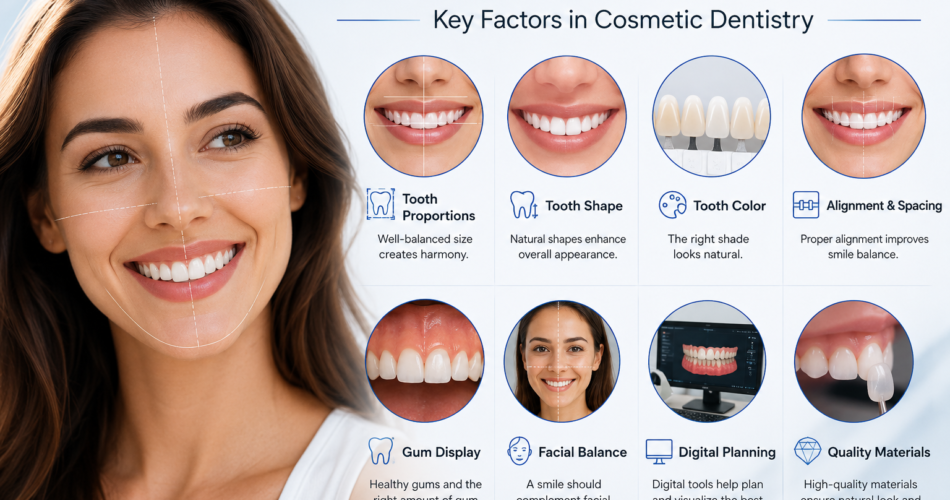
A natural-looking smile is not necessarily the one with the whitest or most perfectly uniform teeth. In cosmetic dentistry, a smile can appear natural when different elements work together in a balanced way.
Tooth shape, size, color, alignment, gum visibility, and facial features can all influence how a smile is perceived. This is why cosmetic dental treatment requires more than simply selecting a procedure and changing the appearance of the teeth.
Understanding these factors can help patients have more realistic expectations when considering cosmetic dental treatment.
Tooth Proportions Matter
The size and proportions of teeth are important characteristics of a natural-looking smile.
Teeth that are significantly too long, too short, too wide, or too narrow may appear noticeable even when their color looks attractive.
The front teeth are particularly important because they are highly visible when a person smiles.
Dentists may consider the relationship between tooth width and length, as well as how individual teeth relate to the neighboring teeth.
The goal is not necessarily to make every tooth identical. Natural smiles often contain small variations that contribute to their appearance.
Tooth Shape Can Influence the Overall Smile
Tooth shape is another important factor.
Some people naturally have more rounded tooth edges, while others may have straighter or more angular shapes. Choosing a shape that works with the individual’s facial characteristics can contribute to a more harmonious result.
When several teeth are being restored, the shape of one tooth can also affect how the others appear.
This is why cosmetic planning often considers multiple teeth together rather than treating each tooth as an isolated feature.
Color Is Only One Part of the Picture
Many people associate cosmetic dentistry primarily with whiter teeth.
Although tooth color can influence the appearance of a smile, extremely white teeth do not automatically create a natural result.
Natural teeth can contain subtle variations in shade, translucency, and brightness. Restorations may therefore need to be selected carefully so that they complement the surrounding teeth and overall smile.
Patients considering whitening or cosmetic restorations should discuss their desired shade with their dentist rather than choosing a color based only on photographs or trends.
Alignment and Spacing Affect Smile Balance
The position of teeth can significantly influence how balanced a smile looks.
Crowding, spacing, rotations, and differences in tooth position may affect the overall appearance.
Depending on the patient’s situation, orthodontic treatment, bonding, veneers, or other approaches may be considered.
The appropriate treatment depends on the underlying dental condition and the patient’s goals.
A cosmetic procedure should not be selected simply because it can change the appearance of a tooth. The dentist must also consider whether the treatment is suitable for the patient’s oral health and function.
Gum Display Is Also Important
Teeth are not the only visible structures when a person smiles.
The amount of gum that appears above the teeth can influence the overall proportions of the smile.
Some people naturally show more gum when smiling, while others show very little.
The appearance of the gum line can also vary between different teeth. For this reason, dentists may evaluate gum contours and gum health when planning cosmetic treatment.
Healthy gums are important not only for appearance but also for the long-term success of many dental treatments.
Facial Features Influence the Smile
A smile exists within the context of the entire face.
Facial proportions, lip position, symmetry, and the way the lips move during smiling can all influence how teeth are perceived.
This is one reason why a dental design that looks attractive on one person may not necessarily be appropriate for another.
Cosmetic dentistry should therefore be personalized rather than based entirely on a standard template.
Digital Tools Can Support Smile Planning
Modern dental technology provides additional ways to evaluate these characteristics before treatment.
Photographs, digital scans, measurements, and other records can be used to study tooth proportions, alignment, facial relationships, and smile characteristics.
A digital smile design approach can help organize this information and provide a visual reference when discussing possible cosmetic changes with a dentist.
Digital planning can be particularly useful when several aesthetic factors need to be considered at the same time.
However, a digital simulation should not be considered a guarantee of the final result. Clinical conditions, tooth structure, soft tissues, materials, and treatment techniques can all influence the outcome.
The Importance of Material Selection
The material used for a dental restoration can also influence how natural it looks.
Depending on the treatment, dentists may consider different materials for veneers, crowns, or other restorations.
Patients can ask their dentist why a particular material has been recommended and how it is expected to perform.
It can also be useful to understand who manufactures or fabricates the restoration and how its quality is controlled.
Knowing these details gives patients a better understanding of what they are receiving rather than focusing only on the appearance shown during a consultation.
Natural-Looking Does Not Mean Perfect
One common misconception about cosmetic dentistry is that the ideal smile should look completely uniform.
In reality, small variations can contribute to a natural appearance.
Slight differences in translucency, tooth shape, and surface characteristics can make teeth appear less artificial.
The objective of cosmetic treatment should therefore be to create a smile that is appropriate for the individual patient, not simply to reproduce a generic “perfect” smile.
What Patients Should Discuss With Their Dentist
Before choosing cosmetic treatment, patients should have an open conversation with their dentist.
Useful questions include:
- What aspects of my smile could be improved?
- Which treatment options are available?
- Why is a particular treatment recommended?
- How will the treatment affect my existing teeth?
- What material will be used?
- Who will fabricate the restoration?
- What are the limitations of the treatment?
- What maintenance will be required?
These questions can help patients understand both the aesthetic and practical aspects of treatment.
A Balanced Approach to Cosmetic Dentistry
Creating a natural-looking smile involves more than changing tooth color or making teeth perfectly straight.
Tooth proportions, shape, alignment, gum display, facial characteristics, materials, and patient preferences can all contribute to the final appearance.
Modern digital tools can support the planning process, but they should be combined with professional examination and clinical expertise.
The best cosmetic treatment is not necessarily the most dramatic one. In many cases, a carefully planned and personalized change can create a result that looks balanced and appropriate for the individual.
Conclusion
A natural-looking smile is created through balance rather than perfection. Tooth shape, proportions, color, alignment, gum display, facial features, and restoration materials can all influence how a smile appears.
For patients considering cosmetic dentistry, understanding these factors can make treatment discussions more meaningful and help establish realistic expectations.
Digital planning can provide additional visual support, while professional clinical assessment remains essential for determining which treatment is appropriate.
Ultimately, cosmetic dentistry should aim to create a smile that complements the individual rather than simply following a one-size-fits-all idea of perfection.